The AI Race Just Changed Course
The GPU war is over. Companies like Nvidia are leading the design war that has begun.
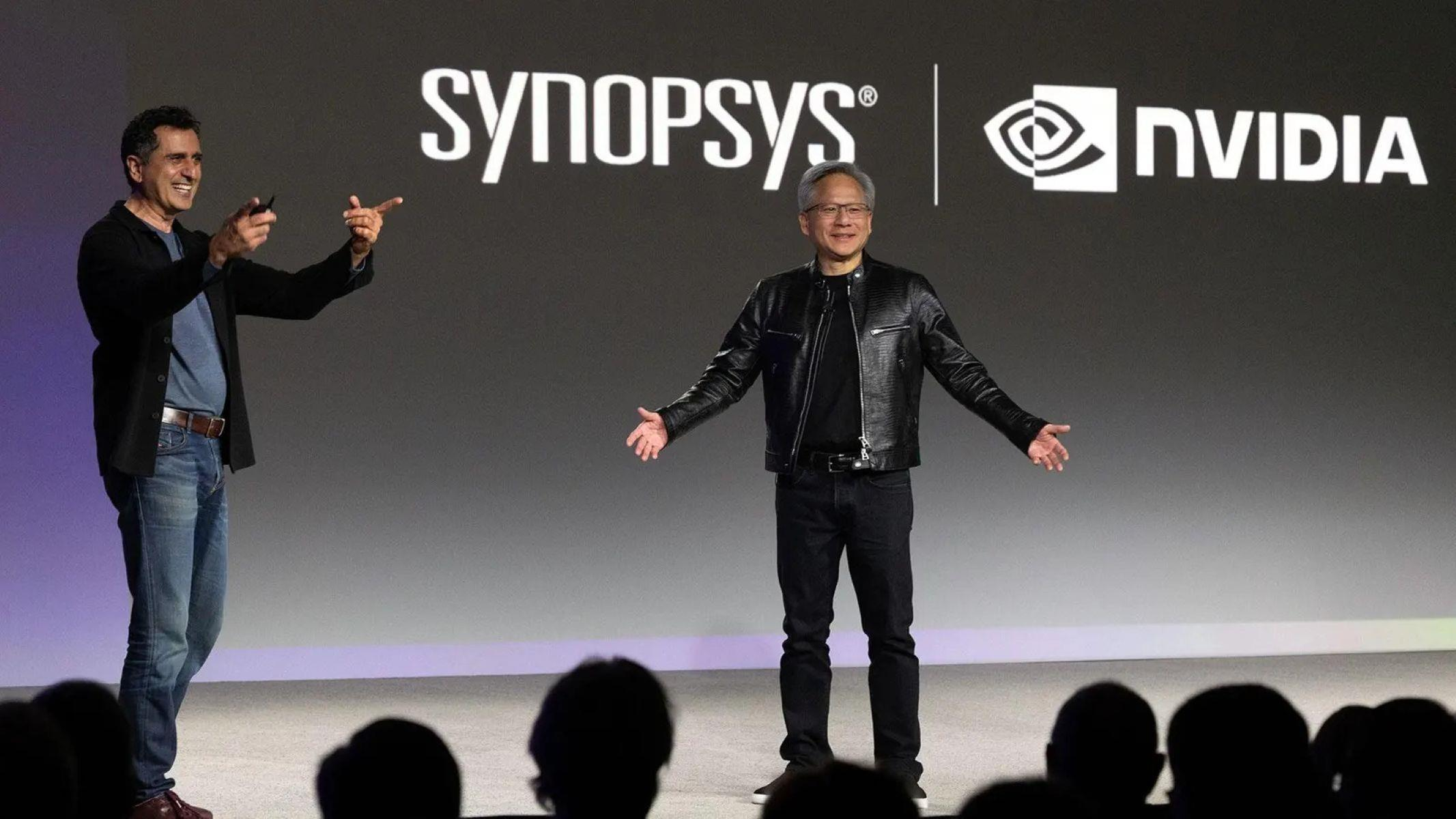
NVIDIA’s $2 billion bet on Synopsys isn’t just another tech partnership—it’s a signal that the semiconductor value chain is shifting beneath our feet. While everyone watches GPUs battle TPUs, the real competition has moved upstream to where chips are born: the design phase.
The $2 Billion Question: Why Synopsys?
NVIDIA (NVDA) has invested $2 billion in Synopsys (SNPS), the world’s leading electronic design automation (EDA) company. The deal includes equity purchased at $414.79 per share and a multi-year strategic partnership focused on AI-powered chip design and simulation tools.
Market reaction? Synopsys shares surged 7-8% in pre-market trading. Investors immediately recognized what this means.
But here’s what most analysts missed: This isn’t about hardware. It’s about the infrastructure that creates hardware.
Meet the Company That Designs the Designers
Who is Synopsys?
Founded in 1986, Synopsys dominates the EDA space—the software that makes chip design possible. Every major semiconductor company relies on Synopsys tools for logic design, layout, verification, and simulation.
In July, Synopsys completed its acquisition of Ansys, a leader in industrial simulation software. This wasn’t just expansion—it was transformation. Synopsys evolved from designing individual chips to engineering entire systems, including multi-physics simulation, advanced packaging, and system-level verification.
The result? Synopsys now controls the entire design stack, from transistor to system.
The Bottleneck Nobody Saw Coming
Here’s the uncomfortable truth about AI chips: Manufacturing is fast. Design is slow.
As AI models evolve exponentially, chip complexity has exploded. Advanced SoCs, multi-die packaging, and cutting-edge process nodes demand verification levels that were unthinkable five years ago. Thermal management, power integrity, signal validation—every dimension has become exponentially more complex.
The problem: Chips can be fabricated quickly. But designing them? That takes time. And in AI, time kills competitive advantage.
Synopsys CEO highlighted this precisely: “The complexity and cost of designing next-generation intelligent systems require integrating AI with high-performance computing.”
According to both companies, combining Synopsys tools with NVIDIA’s GPU and CUDA platform can accelerate chip simulation speeds by up to 30x.
Translation: The design bottleneck just got demolished.

Source: Nanobanana & Synopsys
Two Empires, Two Strategies
To understand NVIDIA’s move, compare it with Google’s approach. Both are strengthening AI infrastructure, but their philosophies couldn’t be more different.
Google: Vertical Integration
Google built its own AI chip (TPU), deployed it in proprietary data centers, and runs cloud services (Gemini) on top. Everything—from silicon to software—stays in-house.
Advantages: Maximum optimization, cost control, and profit margin improvement. Recent TPU revenue growth and improved Google Cloud AI profitability prove this model works.
NVIDIA: Horizontal Expansion
NVIDIA dominates GPU markets but has historically relied on external design tools. This Synopsys investment strategically connects NVIDIA to the front-end design ecosystem—but keeps Synopsys independent.
Crucially, the partnership is non-exclusive. Synopsys can still serve NVIDIA’s competitors.
Google locks down the value chain. NVIDIA opens it up—while positioning its platform as the industry standard.
Which strategy wins? Too early to call. But they’re playing entirely different games.
The Value Chain Just Flipped
Traditional semiconductor value flow looked like this:
Design → Foundry → Packaging → Systems
For decades, attention focused on foundries (TSMC, Samsung) and fabless designers (NVIDIA, AMD). Manufacturing captured the spotlight and the margins.
AI changed everything.
Now, the bottleneck isn’t fabrication—it’s design. You can have the world’s best foundry, but if design lags, products miss market windows. If verification fails, post-production defects explode.
Design became the new chokepoint.
EDA companies are no longer “support software providers.” They’re infrastructure kingpins. Synopsys and its rival Cadence (CDNS) have become the foundation on which the entire AI chip ecosystem rests.
Cadence’s AI-powered design platform, Cerebrus, slashed high-performance chip design time from six weeks to two. Some analysts now call Synopsys and Cadence the “semiconductor-software kings” with a decade-plus growth runway ahead.
What India’s Semiconductor Ambitions Reveal
India’s push into semiconductor manufacturing offers a revealing parallel. The country recently announced massive incentives to build domestic chip fabrication capacity, partnering with global players to establish fabs and ATMP facilities.
The catch? India has abundant engineering talent but limited advanced design infrastructure. Without robust EDA capabilities and design partnerships, manufacturing capacity alone won’t close the gap.
This mirrors the global shift: Fabs are necessary but insufficient. Design infrastructure determines who leads.
Countries and companies investing only in manufacturing may find themselves holding expensive tools with nothing to build. Those who control design—or partner with design leaders—will shape the roadmap.
The Real Competition: Design Infrastructure
NVIDIA’s Synopsys bet answers recent concerns about Google’s TPU momentum. But it’s also something bigger—a repositioning around the next competitive frontier.
GPU wars: NVIDIA won.
Data center wars: Hyperscalers reached equilibrium.
Next battlefield: Who designs AI chips faster and better?
NVIDIA already locked in developers through CUDA. Now, by integrating design tools, NVIDIA’s platform becomes the default across the entire chip development lifecycle.
When design tools, simulation environments, and compute platforms all center on NVIDIA, switching costs skyrocket. This isn’t just market share—it’s ecosystem capture.

Source: Gemini 3.0
What Investors Should Watch Now
The question has shifted. Don’t ask: “Which chip company is best?”
Ask: “Who solves the design bottleneck?”
Three Investment Archetypes Emerging:
1. Vertical Integrators (Google, Amazon)
Own the full stack from chip to service. Strongest revenue contribution from AI, clearest cash flow.
2. Horizontal Expanders (NVIDIA, Synopsys)
Control platforms and standards. Focused on industry leadership over immediate margin capture.
3. Hybrid Players (Microsoft, Meta)
Mix of proprietary AI tools, cloud infrastructure, and partner ecosystems. Diversified exposure.
If your semiconductor portfolio still centers exclusively on fabless designers and foundries, you’re missing the shift. EDA companies, IP licensors, and simulation tool providers are becoming the new value hubs.
Synopsys, Cadence, and Arm Holdings—companies that own design standards or design infrastructure—deserve reevaluation.
The Verdict: A Structural Turning Point
NVIDIA’s Synopsys investment isn’t just a partnership announcement. It’s a structural signal that AI value chains are extending downward into foundational infrastructure.
AI infrastructure no longer means just GPUs and data centers. It now includes design, verification, simulation, and full-stack tooling.
The semiconductor industry’s center of gravity is moving. Upstream. Toward the blueprint, not just the building.
Those who control how chips are designed will ultimately control what gets built—and what gets built determines who wins the AI race.
See more insightful news!
- “Google vs NVIDIA: Which AI Powerhouse Offers the Better Investment Now?”
- “Oracle’s AI Revolution: The 36% Surge That Changed Everything”
- “China’s Global AI Ambition: The Shocking Strategy Behind Its New Action Plan”
- “Decoding the Fed’s Warning: How $1.1 Trillion in Margin Debt Threatens Your Portfolio”
- “Exclusive: Google Pixel 10’s Hyper-Personalized AI Stuns Jimmy Fallon”
