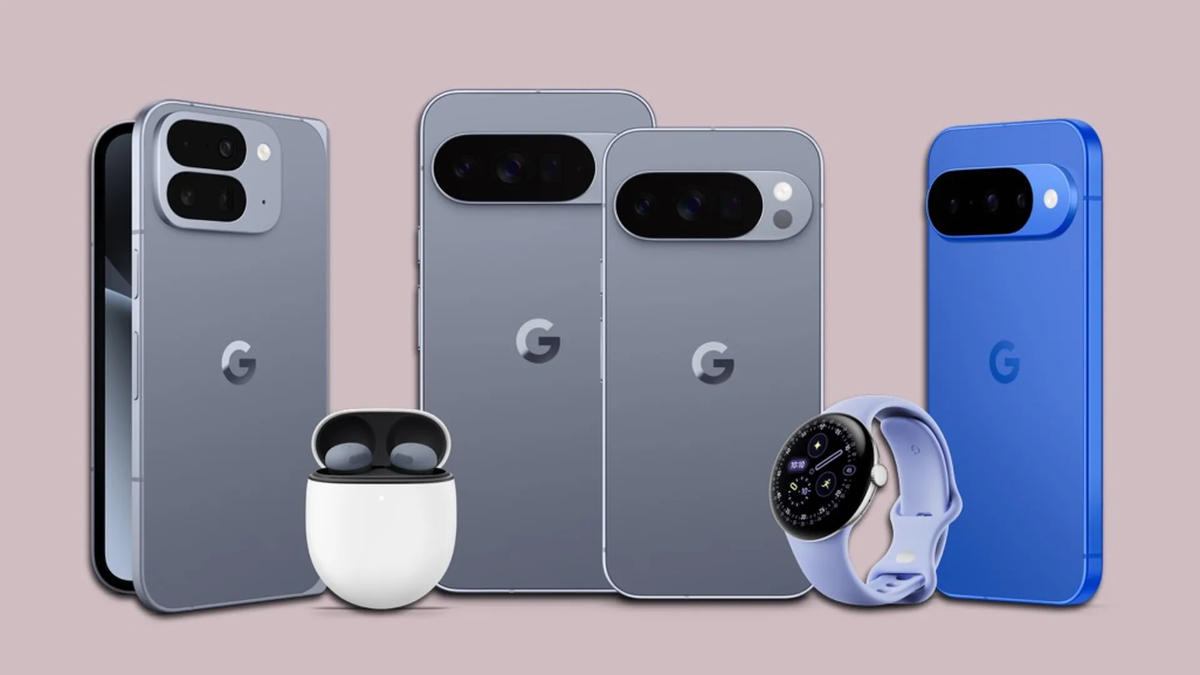
[Made by Google] New products unveiled including Pixel 10 Pro, Pixel 10 Pro Fold, and the Google Pixel 10.
‘Magic Cue’ goes beyond reactions to predictions… Hyper-personalization based on agentic AI
On-device AI potential 60% more powerful Tensor G5 chip is key
English-Spanish real-time call demonstration ‘Camera Coach’ feature draws attention
“Jimmy, where did we decide to have dinner tonight?”
When Jimmy Fallon, the MC of America’s popular talk show “The Tonight Show,” opened his smartphone messaging app, the name of a Cuban restaurant in Manhattan, New York – “Coppelia” – appeared.
The AI automatically generated a response by combining information from the message sender, Rick Osterloh, and the message receipt date and time. It also included details from the restaurant reservation confirmation email. Fallon was able to recall making the restaurant reservation and complete his response in just one second. He simply pressed the send button, without having to additionally search through emails or calendar apps.
This was made possible by the new “Magic Cue” feature applied to Google’s new smartphone “Pixel 10 Pro,” announced on the 20th (local time).
Google’s “Made by Google” event held that afternoon in Brooklyn, New York, was more than just a simple product launch. It was an event that showcased the future of AI devices. The key point was Google’s declaration of a transition from technology that reacts to user demands to a stage where it “predicts and suggests” user needs proactively.

Google Pixel 10 Pro (Source: Google)
‘Magic Cue’ Beyond Reactions to Predictions… Hyper-Personalization Based on Agentic AI
Jimmy Fallon, who demonstrated Magic Cue live on stage that day, repeatedly exclaimed “fantastic.” This was because Magic Cue could literally function as a hyper-personalized AI assistant that “knows me better than I know myself.”
When Senior Vice President Osterloh sent an additional message asking, “Can you call the restaurant and push back our reservation time a bit?”, Magic Cue presented a button to directly call the restaurant along with response examples like “Of course.” Without the user having to search for the restaurant’s phone number, the AI understood the message content. It automatically found the necessary information and even drafted the message response.
Fallon simply had to choose and tap from the options the AI assistant presented. There was no need to close the message window, open other apps, or do any typing. “Agentic AI,” where AI performs some tasks on behalf of humans, was close at hand as an actual product, and specifically on mobile devices.
Tyler Kugler, Google Product Manager, explained, “The more you do with your smartphone, the more you end up digging through multiple apps to find the information you need. Magic Cue connects various apps like Gmail, Calendar, screenshots, and messages. It proactively displays relevant information and suggests useful actions when needed.”
This is where Google’s powerful app ecosystem, with its user base of billions worldwide, shines. To achieve hyper-personalization, you need to secure as much user data as possible, and Google already possessed this asset.
He emphasized, “You can turn Magic Cue on or off at any time and control what data it can access. It runs safely and privately.”

Google Tensor G5 processor (Source: Google)
On-Device AI Potential… 60% More Powerful Tensor G5 Chip is Key
The background to Google’s ability to provide innovative AI features while emphasizing security performance lies in their self-developed fifth-generation processor for Pixel, the “Google Tensor G5.”
The high level of security comes from the fact that data is not shared externally to the cloud. AI computations are completed within the smartphone using the high-performance built-in chip.
Jesse Seed, Google Group Product Manager, explained, “Tensor G5 is the first chip to run the latest Gemini Nano model. Through close partnership with Google DeepMind, it provides various on-device generative AI experiences.”
According to Google, Tensor G5 includes a TPU (Tensor Processing Unit) that is up to 60% more powerful. It also features a CPU that is 34% faster compared to the previous generation G4 chip.
The global smartphone market is already focusing on AI as a new growth engine. Market research firm Omdia forecasts that by 2028, smartphones with AI capabilities will account for 54% of shipment share. This will be driven by rapid advancement in chipset technology and increasing consumer demand for AI-based features.
It’s not easy for Google to surpass Samsung in hardware manufacturing capabilities or Apple in strong ecosystem loyalty. For this reason, Google was moving the competitive landscape to AI, where they have the greatest advantage. The emphasis on processor and on-device AI “intelligence levels” in this Pixel 10 announcement can be interpreted in this context.

AI-powered Camera Coach feature examples (Source: Google)
English-Spanish Real-Time Call Demonstration… ‘Camera Coach’ Feature Draws Interest
Various useful AI-based new features with practical applications were also unveiled.
Beyond Magic Cue, an improved real-time voice translation demonstration received great response. Fallon conducted a phone conversation with a demonstrator in Mexico, conversing in English and Spanish. Each person could communicate using only their familiar language.
What was particularly impressive was that real-time voice translation reflecting each speaker’s voice was performed based on the Tensor G5 chip installed in Pixel 10. The Spanish interpretation was delivered in Fallon’s voice.
Google explained, “You can naturally communicate in the other person’s language and break down language barriers. Voice translation works when translating Spanish, German, Japanese, French, Hindi, Italian, Portuguese, Swedish, Russian, and Indonesian to English, or vice versa.”
Camera Coach is a feature that uses Gemini models to inspire new ideas and help explore photos you might not have considered before. For example, when you open the camera app and point it at a subject, AI guides you to take better photos through real-time messages. These include tips like “Ask your subject to look at the camera” or “Move closer to your subject.” The “edit by asking” feature, which allows you to modify photos with voice commands, was also interesting.

A scene demonstrating real-time phone calls in Spanish and English. The user’s voice is translated into the other language.
Insight Bridge AI’s Perspective: Google Preparing for the AI Hardware Era
Google equipped all four models unveiled this time – Pixel 10, Pixel 10 Pro, the large-screen Pixel 10 Pro XL, and the foldable Pixel 10 Pro Fold – with the next-generation AI chip Tensor G5 and on-device AI model Gemini Nano equally.
This embodies a philosophy of providing consistent high-performance AI experiences to all Google hardware users. Rather than concentrating AI features only on certain high-end models, the strategy is to have as many users as possible experience Google AI. This will ultimately lead users to seek better AI experiences.
This can also be interpreted as preparation for the future era of AI-based smart devices like smart glasses after smartphones. Google is confident that AI will ultimately be the key differentiating factor in the smart glasses field as well.
Looking at the history of the smartphone market, hardware performance eventually went through a process of standardization. Google showed remarkable improvements in hardware areas with the Pixel 10 Pro Fold. They applied a new “gearless hinge” that is twice as durable as the previous generation. It also supports IP68-rated water and dust resistance – a first for foldable phones. While hardware can be caught up to somewhat later, it’s highly likely that Google judged that AI, sophisticated based on a massive customer base and data foundation, would not be easily matched.
The unveiling of accessories beyond Pixel phones – including the “Pixel Watch 4” supporting standalone satellite communication, “Pixel Buds 2a,” and the “Pixelsnap” wireless charger based on the open collaborative wireless charging standard “Qi2” – follows the same logic. This can be interpreted as a move to gradually expand the accessory line. It also extends Google’s ecosystem influence in preparation for the AI hardware era.
See more insightful news.
- “Palantir vs AMD Earnings Report… The Watershed Moment of AI Infrastructure Competition”
- “The Reality of 2025’s ‘K-Shaped Recovery’: The Worst Era of Polarization Since the Great Depression”
- “Figma’s IPO: A Game Changer for Design Tech”
- “Meta Mark Zuckerberg Proposes ‘Personal Superintelligence’ Strategy Building AI Vertical Integration Ecosystem”
- “China’s AI Semiconductor Surge: A Direct Challenge to NVIDIA”
