Figma IPO Analysis
Figma’s Success Driver ①: AI-First Strategy… Expanding the Market
Figma’s Success Driver ②: Product-Led Growth… Once You Use It, You Keep Using It
Figma’s Success Driver ③: Collaboration DNA… From Isolation to Organic Collaboration
Insight Bridge AI’s Perspective: Performance Proven by Numbers… Time to Execute AX Now. Amidst these strategies, the anticipation of an IPO could be an important milestone for Figma’s future growth.
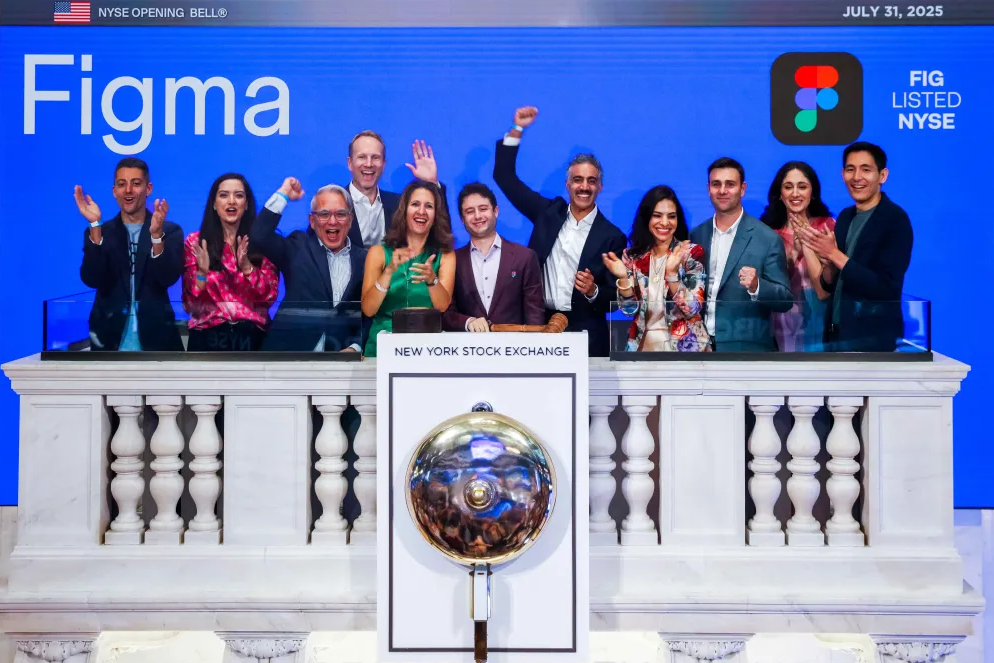
At 9:30 AM on July 31, 2025, New York Stock Exchange (NYSE).
Dylan Field, CEO of Figma, and his employees standing at the opening bell podium erupted in enthusiastic cheers as the bell rang to signal the market opening.
This was the moment when Figma, which revolutionized the design software landscape, began its first trading under the ticker symbol ‘FIG’. Figma’s IPO price was set at $33 per share, exceeding the initially expected range of $30-32, already signaling intense market interest. However, the actual market fervor that day far exceeded expectations.
As soon as trading began, the stock price soared 158% above the IPO price, opening at $85, and ultimately crossed $100 during the session to close at $115.50 (a 250% increase from the IPO price). Figma’s market capitalization following the first-day surge reached approximately $50 billion (about 69.81 trillion won). This figure more than doubled Adobe’s acquisition proposal of $20 billion from September 2022. Adobe’s abandonment of the Figma acquisition in December 2023 due to regulatory issues had indeed become a “blessing in disguise.”
Figma’s successful IPO transcends a simple corporate success story. It can be interpreted as the market’s clear “verdict” on regulatory decisions.
The open market, where countless investors’ independent judgments converge, valued Figma’s independent worth at $50 billion. Regulatory authorities’ concerns that Adobe’s acquisition of Figma would hinder innovation and competition in the design software market were not unfounded, and ultimately served to unlock Figma’s value.
Figma’s debut also signals the revival of the tech company IPO market, which had been stagnant for the past three years. Since 2021, numerous unicorn companies that had achieved high valuations hesitated to go public, fearing market cap declines.
Figma’s IPO dispelled these concerns and proved that the market is willing to pay premiums for companies with solid fundamentals. This is particularly positive news for other large tech companies awaiting public offerings, such as Canva and Databricks. Some observers suggest this could lead to a new rally of tech stock listings.
How did Figma manage to transform the crisis of a failed M&A into a brilliant opportunity? Figma’s IPO success was built on three powerful growth engines: AI-first strategy, product-led growth, and collaboration DNA.

Figma logo displayed at the New York Stock Exchange (Source: Figma X)
Figma’s Success Driver ①: AI-First Strategy… Expanding the Market
Figma’s explosive market capitalization cannot be explained by financial performance alone. At its foundation lies the organic combination of three core strategies that transformed the product’s essence, exponentially increased the user base, and built an unassailable moat against competitors.
The most prominent growth engine is the AI-first strategy. In its S-1 filing submitted before going public, Figma stated, “AI will be central to future design workflows,” and “we plan to double our AI investment over the coming years, even if it burdens efficiency in the short term,” emphasizing a strong AI-first strategy.
AI was also the central theme of Figma Config 2025, held in San Francisco last May. CEO Dylan Field’s keynote presentation showcased new AI-based features, earning enthusiastic responses from Figma’s primary user base of designers.
These strategic moves evolved Figma from a simple design tool into an AI-powered creative platform. Features like ‘Figma Make’ and ‘First Draft’ are prime examples. These functions allow users to instantly generate editable design mockups and wireframes simply by inputting text prompts. By enabling anyone, not just professional designers, to visualize ideas, they dramatically lowered the barriers to design entry.
‘Dev Mode’ follows the same principle. This feature automatically converts completed designs into code that developers can use, breaking down the long-standing barriers between designers and developers. Previously, the process of developers reinterpreting and coding designers’ outputs was time-consuming and error-prone. By automating and simplifying this process, Figma established itself as an invaluable tool throughout the entire software development lifecycle, not just design.
Fortune also played a role in executing the AI-first strategy. The $1 billion (approximately 1.4 trillion won) breakup fee provided by Adobe when it canceled the acquisition contract became a massive resource secured without costs like equity dilution or interest. Figma concentrated this funding on AI R&D investment, preparing for the future.
While traditional design tool markets were limited to designers, Figma used AI features to bring all stakeholders involved in product development—developers, planners, marketers—into the platform. This fundamentally expanded Figma’s Total Addressable Market (TAM) beyond the narrow category of “design tools.” According to Figma, two-thirds of its current 13 million monthly active users are non-designers. The company has approximately 450,000 paying customers.
Figma’s Success Driver ②: Product-Led Growth… Once You Use It, You Keep Using It
Another pillar explaining Figma’s growth is its ‘Product-Led Growth (PLG)’ strategy. Instead of pouring massive marketing budgets, they made the product’s inherent appeal and utility the driving force for users to voluntarily become advocates for expansion.
Figma adopted a ‘Freemium’ business model that allows individuals and small teams to use core features for free. Without needing to go through sales representatives, users can immediately experience Figma in web browsers and become captivated by its powerful collaboration features.
The ‘good experience’ users felt naturally led to recommendations to colleagues, organically spreading throughout organizations.
The success of this strategy is supported by numbers in the S-1 report. Figma is used by 95% of Fortune 500 companies and has successfully penetrated 78% of Fortune 2000 companies.
Once established in organizations, Figma generates revenue through conversion to paid customers and expansion of existing customer spending, surpassing 11,100 paying customers with Annual Recurring Revenue (ARR) of $10,000 or more. This represents a 39% increase from the previous year.
The pinnacle of Figma’s product-led growth model lies in its industry-leading ‘Net Dollar Retention (NDR)’. Figma’s NDR is 132%, meaning that even after accounting for revenue loss from customer churn, existing customers pay 32% more the following year.
This shows that customers who experience Figma once successfully expand usage to more team members and upgrade to more expensive plans.
This organic growth translates to remarkable sales efficiency. As of 2023, Figma generates $1 in new gross profit the following year for every $1 spent on sales and marketing. This is overwhelmingly higher compared to Adobe’s $0.39. This proves that customer satisfaction with Figma’s products is exceptionally high, and the product-led growth model based on this satisfaction is highly efficient.

Figma Key Business Metrics (Source: Figma S-1, SEC)
Figma’s Success Driver ③: Collaboration DNA… From Isolation to Organic Collaboration
The final engine lies in the core DNA of ‘collaboration’. When Figma first appeared, the most innovative aspect was its web browser-based capability allowing multiple users to simultaneously access and work on a single project in real-time.
This fundamental difference transformed design work from individual isolated tasks to organic team collaboration activities. This completely revolutionized work methods, differing entirely from Adobe software that requires desktop installation.
Figma expanded this collaboration DNA across the entire platform. The online whiteboard tool ‘FigJam’ supports team brainstorming and ideation meetings, ‘Figma Slides’ enables collaborative presentation creation, and ‘Figma Sites’ allows design outputs to be directly published as websites.
This diversification strategy has successfully established itself in the market. 76% of all customers use two or more Figma products together, supporting the high 132% NDR.
When the entire product development process—from ideation (FigJam), design (Figma Design), developer handoff (Dev Mode), to result presentation (Figma Slides)—can be performed on a single platform, powerful network effects occur.
More members and teams within organizations integrate their work around Figma. Consequently, the value of the Figma platform increases, while the cost of switching to other tools rises. This effectively prevents customers from leaving.
One reason investors valued the company at $50 billion is this ‘potential as an irreplaceable platform.’

Product Development Process Utilizing the Figma Platform (Source: Figma S-1, SEC)
Insight Bridge AI’s Perspective: Performance Proven by Numbers… Time to Execute AX Now
According to the S-1 report, Figma’s revenue growth rate (46%) is four times that of tech giant Adobe (11%) and far exceeds industry averages. The 91% gross profit margin proves how efficient and scalable Figma’s cloud-based Software-as-a-Service (SaaS) model is.
Under the ‘Rule of 40’ (revenue growth rate + operating profit margin), a key metric evaluating the balance between growth and profitability for SaaS companies, Figma recorded an remarkable 64%. This places it in the top 5% among public SaaS companies.
While Figma recorded a net loss in its most recent fiscal year according to the S-1 report, this was largely due to one-time stock compensation costs (approximately $900 million) related to the IPO. Excluding these costs, the company is near break-even, and in Q1 2025, it recorded $44.9 million in net profit, successfully achieving profitability. The company maintains debt-free operations and is evaluated as having solid financial stability.
Bold AI investment played a crucial role in impressing investors with Figma’s long-term vision and competitiveness. PitchBook Data analyst Derek Hernandez told MarketWatch, “I don’t think I’ve seen a company this good in a while,” evaluating it as “a SaaS company that has secured a monopolistic position in the product design market.”
Figma’s IPO success offers insights for Korean companies where AI Transformation (AX) is a hot topic across all industries. While using AI to automate and streamline existing business processes is an important first step, companies shouldn’t stop there.
Figma painted a bigger picture of using AI to transform the company’s essence and the market itself. Korean companies also need to redefine AI as a core growth engine beyond a cost-cutting tool to secure future growth drivers. They must consider how to create new business models through AI and expand their Total Addressable Market (TAM) by breaking down existing market boundaries.
One approach could be establishing an ‘AI Control Tower’ directly led by C-level executives, enabling bold investment execution under a company-wide vision.
A mindset shift starting from ‘customer problems’ rather than technology is also important. Figma’s successful AI features weren’t for technological showmanship. They had clear goals of solving chronic collaboration issues between designers and developers.
The key to successful AI adoption lies not in the technology itself, but in clearly defining the business problems to be solved. True competitiveness can emerge when engineers and practitioners with field data and knowledge can directly participate in AI service development, and their expertise is combined with AI technology.
Building a data-driven collaboration culture is also crucial. The foundation of Figma’s competitiveness was collaboration. AI played a role in amplifying this collaborative value.
For a data-driven decision-making culture to take root throughout an organization, efforts must first be made to break down data silos within companies and secure high-quality data. Companies must also stake their survival on talent acquisition. Rather than relying solely on external hiring, they need to establish internal development systems that actively support retraining existing personnel and career transitions so they can acquire capabilities needed in the AI era. When these efforts combine, Figma’s success can become reality rather than a distant story.
See more insightful news!
