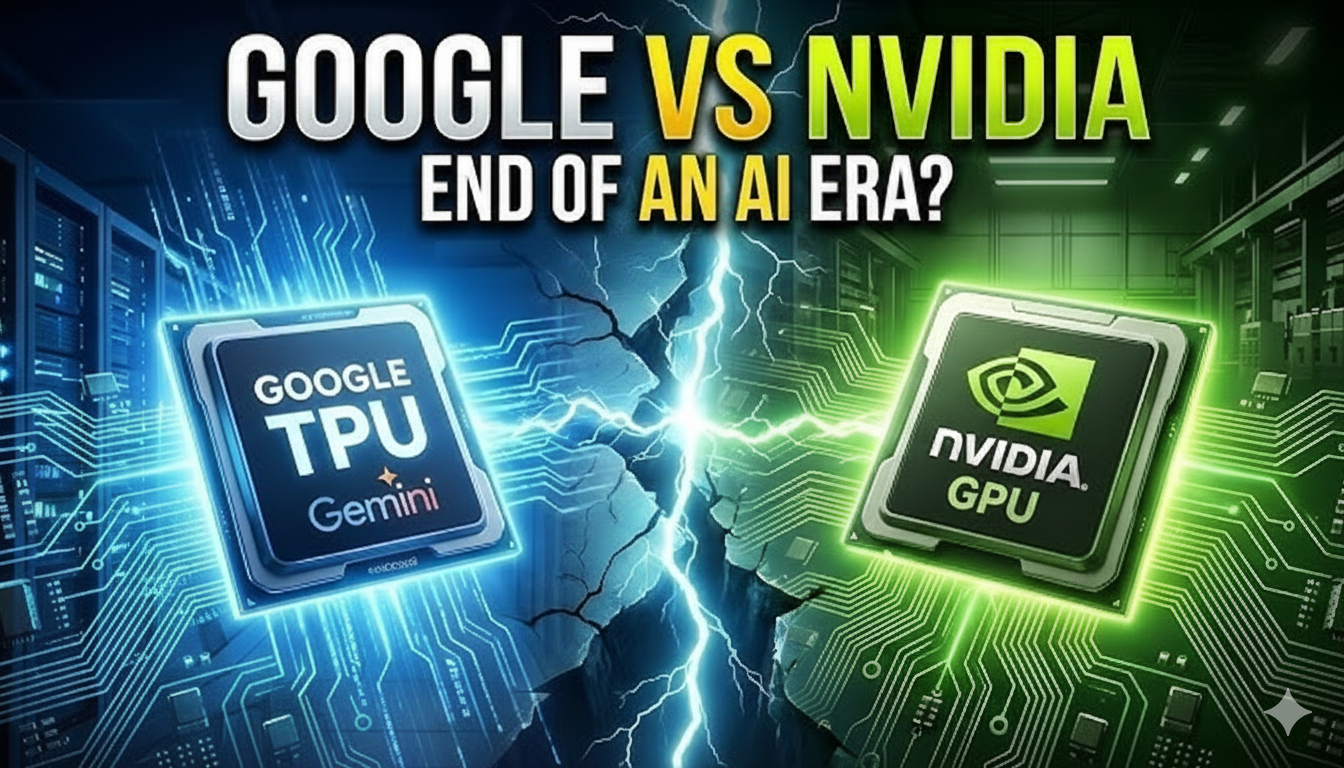
The GPU standard is crumbling, as TPU technology promises new advancements. AI chips enter a new era.
Vertical integration vs. versatility: Google’s full-stack play changes everything.
Multi-vendor strategies emerge as TPU and GPU coexist, not compete.
Insight Bridge AI perspective: Asking “GPU or TPU?” misses the entire point.
The GPU Standard Cracks: AI Chip Market Flips Overnight
The AI semiconductor landscape just hit an inflection point.
Google’s counterattack against NVIDIA marks the beginning of something bigger.
Meta Platforms is reportedly exploring a multi-billion-dollar deal to adopt Google’s Tensor Processing Units (TPUs). Markets reacted instantly. NVIDIA’s stock dipped while Alphabet’s market cap soared toward $4 trillion.
The reaction might seem excessive. But this signals real fractures in what’s dominated AI infrastructure for three years: NVIDIA’s GPU-as-standard architecture.
Is NVIDIA’s grip on AI infrastructure actually weakening?
Most investors are misreading this moment. This isn’t simply about market share shifting. It’s not just a tech rivalry between NVIDIA and Google.
Sure, the “GPU equals AI chip standard” assumption that ruled the past few years now faces genuine challenge. But what matters more is this: AI industry profit structures are fundamentally reshaping.
Vertical Integration vs. Versatility: Google’s Full-Stack Bet Shifts Power
Google’s TPU is wielding real influence over AI infrastructure ecosystems. But the bigger story is the emergence of vertically integrated platforms.
Google recently unveiled its next-generation language model, Gemini 3.0, trained and powered entirely by its in-house 7th-gen TPU “Ironwood.” This represents complete independence from NVIDIA GPUs. More critically, Google has built a full-stack ecosystem spanning chip design, cloud infrastructure, AI models, and services.
NVIDIA fired back immediately. CEO Jensen Huang declared: “We remain a generation ahead of the industry and the only universal platform running every AI model in every environment.” He emphasized GPU versatility and ecosystem advantage.
Wall Street saw it differently. Morgan Stanley estimated Google could ship 500,000 to 1 million TPUs annually to external customers by 2027, triggering an immediate Alphabet valuation reassessment.
Markets zeroed in on a clear shift: AI demand is moving from model training to large-scale service operations. In this phase, TPU cost efficiency can overpower GPU versatility.
TPU vs. GPU: What’s the Real Difference?
The fundamental divide lies in design philosophy. TPUs use ASIC (Application-Specific Integrated Circuit) architecture optimized for tensor operations. GPUs are general-purpose accelerators handling AI, graphics, high-performance computing, and parallel processing.
If NVIDIA’s GPU is a versatile all-in-one computer, Google’s TPU is a specialized machine guaranteeing superior performance for specific tasks.
Some analyses show TPUs deliver up to 4x better dollar-per-performance for certain AI workloads. For companies processing hundreds of millions of inference requests daily, this isn’t just technical superiority—it’s a profit variable. When power and server costs directly impact bottom lines, TPU efficiency becomes survival, not choice.
Add this: Google designs and operates these chips internally. Using Google’s chips means freedom from supply chain risks, licensing fees, and margin pressure without external dependencies. That’s why large-scale AI service companies find TPUs compelling for long-term cost structures.
Yet GPU ecosystem advantages remain solid. NVIDIA built an integrated ecosystem through CUDA platforms and deep learning frameworks that researchers, enterprises, and cloud providers depend on. For large model training, non-standard operations, and experimental workloads, GPU versatility and flexibility are practically irreplaceable. Some conservative analysts project custom chips won’t exceed 45% of the AI accelerator market by 2028.
Still, markets are already evolving. GPUs dominate in training phases, but in service deployment, specialized efficiency crushes versatility. As AI markets mature, efficiency pressure only intensifies.
Multi-Vendor Strategy: TPU and GPU Combination, Not Competition
Wall Street remains divided on general-purpose versus custom chips.
Morgan Stanley and other major investment banks view TPUs as real market products beyond internal use, positively rating Google Cloud’s revenue growth potential. Conservative analysts counter that GPU ecosystem barriers remain structurally high.
But regardless of Wall Street opinions, markets don’t operate in black and white. This isn’t NVIDIA versus Google.
Investors should recognize this: AI infrastructure competition is no longer a “single winner” game. Multiple research outlets emphasize that total market expansion matters more than market share, projecting TPUs and GPUs will coexist in a multipolar ecosystem, expanding the overall pie for different use cases.
Major AI companies are already exploring multi-vendor strategies combining GPUs, TPUs, and other AI accelerators based on workload characteristics. It’s not choosing GPU or TPU—it’s optimizing by purpose.
Of course, current markets face “expectation amid uncertainty.” Expectations exist, but verification and confirmation remain pending.
TPU ecosystem expansion potential is already reflected in company valuations like Google’s, but actual large customer contracts and revenue results await validation. GPU ecosystems still wield formidable structural market influence.
Investors need balanced perspectives recognizing GPU and TPU will expand AI market size overall. A balanced portfolio distributing investments across NVIDIA, Alphabet, and AI infrastructure players like Oracle, TSMC, Broadcom, Super Micro, and ASML makes strategic sense.
Situations remain fluid. Investors must focus on confirmed demand.
Whether major customers like Meta, Oracle, and Salesforce sign TPU contracts, Google Cloud’s AI revenue growth rates, and NVIDIA’s Blackwell GPU demand trends will determine valuations over the next 12-24 months.

NVIDIA dominates in both total throughput and performance density. The GB200 and B200 solidify this market leadership through superior performance and efficiency. Meanwhile, Google’s TPUv6e offers high density but lower total throughput, suggesting a design specialized for specific workloads (Source: Morgan Stanley)
Insight Bridge AI View: Asking “GPU or TPU?” Is the Wrong Question
The AI semiconductor market isn’t about “who wins: GPU or TPU?”
Many investors trap themselves in this binary thinking. The real question should be: “Where do AI market profit structures originate?”
For Google, chip sales matter less than service margins. Google’s real strategy isn’t selling TPUs—it’s dominating TPU-based cloud services. Google can undercut competitors by 30-40% using TPUs, capturing market share.
NVIDIA can’t easily replicate this structure. NVIDIA profits from chip sales, but Google absorbs chips as internal costs and recovers through service margins. This works because Google provides complete AI infrastructure from chips through services.
The AI semiconductor war’s essence hinges on who captures vertically integrated ecosystems first.
AI markets are moving beyond who supplies or holds more chips. The battle is who controls ecosystems to offer the lowest service prices and capture markets. This capability requires vertical integration.
AI infrastructure isn’t “NVIDIA or Google” or “GPU or TPU.”
Investors all-in on NVIDIA risk repeating mistakes of those who bet on Intel’s peak era. Conversely, investors focused solely on Google might underestimate GPU ecosystem resilience.
AI infrastructure is building unprecedented ecosystems. Whether NVIDIA becomes the next Cisco or Intel—or something entirely different—remains unknown. But one thing is certain: AI market battlegrounds are evolving from chip performance to service pricing, with vertical integration ecosystems determining outcomes.
See more insightful news!
- “The Unexpected Reason ASML Invested In Mistral AI”
- “Oracle’s AI Revolution: The 36% Surge That Changed Everything”
- “China’s Global AI Ambition: The Shocking Strategy Behind Its New Action Plan”
- “Decoding the Fed’s Warning: How $1.1 Trillion in Margin Debt Threatens Your Portfolio”
- “Exclusive: Google Pixel 10’s Hyper-Personalized AI Stuns Jimmy Fallon”
