“Stop Clicking. Just Ask.” — Jensen Huang’s Big Bet
For 40 years, using a PC meant one thing: open an app, click around, type stuff. But with innovations from companies like Nvidia, that’s all beginning to change. Riveting stuff, really.
Jensen Huang just said: that era is over.
At NVIDIA GTC Taipei, NVIDIA and Microsoft unveiled RTX Spark — a brand-new integrated processor (SoC) built from the ground up for AI-native computing. And the market? It listened. NVIDIA’s stock jumped 6.26% to $224.36 in a single session.
That’s not just a chip launch. That’s a declaration of war on 40 years of x86 dominance.
What Is RTX Spark, Exactly?
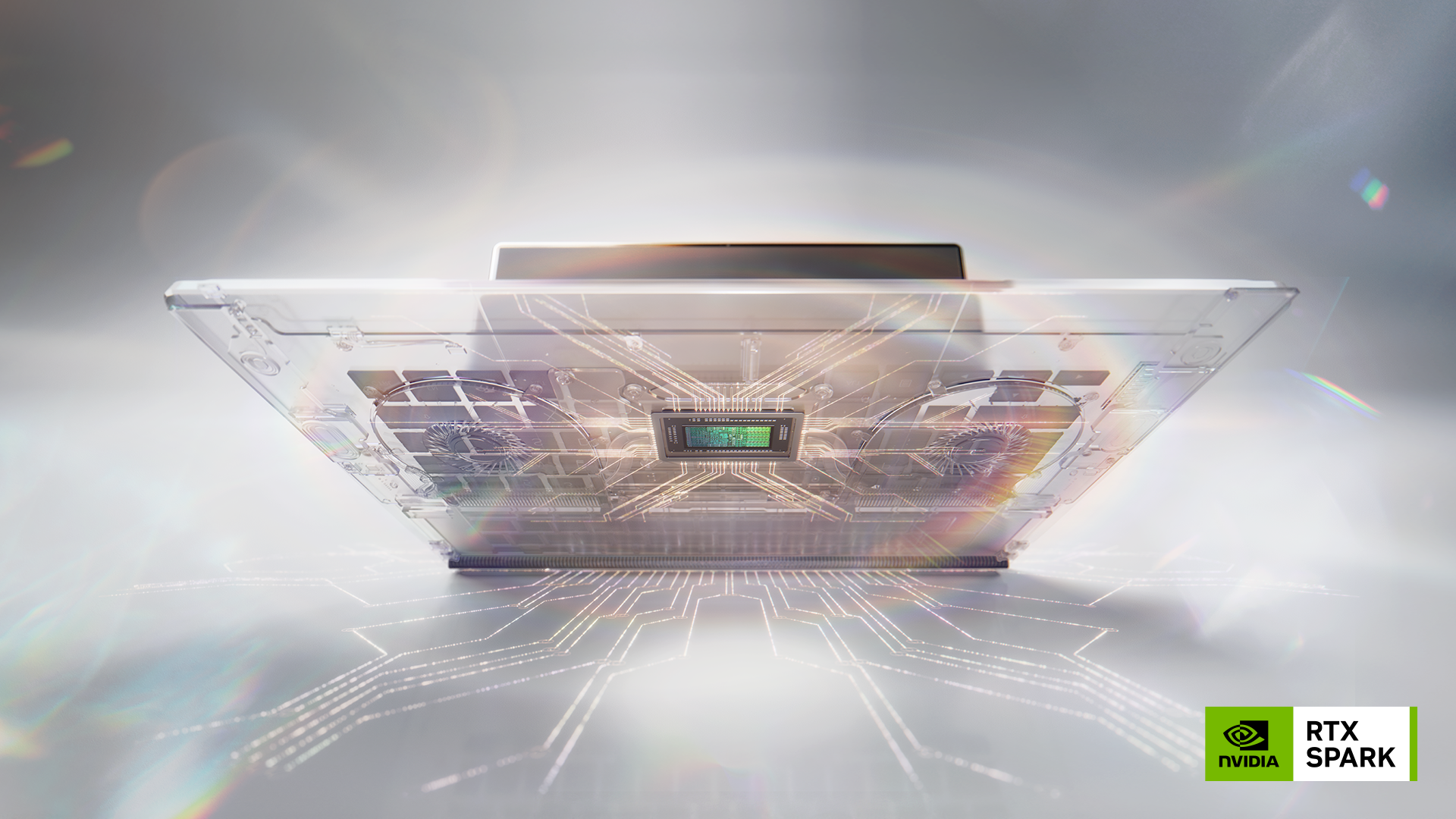
RTX Spark is NVIDIA’s first-ever laptop and desktop SoC — GPU and CPU fused into one superchip.
Here’s what’s inside:
- GPU: NVIDIA Blackwell architecture, 6,144 CUDA cores, 5th-gen Tensor Cores with FP4 precision
- CPU: NVIDIA Grace chip — Arm-based, 20 high-performance cores, co-designed with MediaTek for power efficiency
- Interconnect: NVLink-C2C chip-to-chip link
- Memory: Up to 128GB unified memory
- AI Horsepower: 1 PetaFLOP
What does that actually mean in practice? It can locally run a 12-billion-parameter LLM with up to 1 million token context. It can render 90GB+ 3D scenes, edit 12K video, and generate 4K AI footage — all on-device.
No cloud. No latency. No excuses.
Microsoft Didn’t Just “Support” This. They Rebuilt Windows for It.
This isn’t a “runs on Windows” launch. Microsoft went deep.
Pavan Davuluri, Microsoft’s VP of Windows + Devices, called it “the next step in a multi-year, full-stack collaboration.” Windows itself was reengineered — specifically, the Workload Profile Scheduling (WPS) system was redesigned to intelligently distribute tasks across all 20 Grace cores.
Checking email? Light cores. Running a local AI coding agent? Blast all 20. It’s smart scheduling baked into the OS.
Satya Nadella summed it up: “Infinite intelligence for every home, every desk.” (No pressure, Intel.)
AI Agent Security: NVIDIA OpenShell
Here’s where it gets genuinely interesting — and underreported.
Running AI agents locally is powerful. But who controls what the agent can and can’t do?
NVIDIA introduced OpenShell, a runtime that lets users define explicit permissions for local AI agents — what actions are allowed, what’s blocked, and how queries are routed based on your privacy preferences.
Microsoft added Windows Security Primitives on top: identity verification, sandboxed isolation, and end-to-end secure agent execution.
This is the unsexy-but-critical work that makes AI agents actually trustworthy in real-world use.
Adobe Is Rebuilding Photoshop and Premiere — From Scratch
Yes, really.
Adobe, NVIDIA, and Microsoft announced a joint effort to redesign Photoshop and Premiere Pro specifically for RTX Spark. The expected result: up to 2x AI and graphics performance versus current builds.
Adobe CEO Shantanu Narayen called it a move to make creative work “faster and more powerful.”
So if you’re a video editor or designer still waiting for AI tools to feel native rather than bolted on — this is your sign.
Who’s Building RTX Spark Devices?
ASUS, Dell, HP, Lenovo, Microsoft Surface, MSI, Acer, and GIGABYTE have all committed to RTX Spark-powered products.
Form factor details: 14mm thin, ~1.36kg, 14–16″ tandem OLED displays, precision-machined aluminum chassis.
Consumer availability: fall 2025. Mark your calendar.
The Real Story: NVIDIA Is Pulling an Apple
Here’s the big-picture take from Insight Bridge AI:
NVIDIA built its empire on cloud datacenter GPUs. RTX Spark is a strategic shift toward edge computing and on-device AI — targeting the privacy-conscious user, the low-latency use case, and the enterprise that can’t pipe everything through a cloud.
But the deeper move is the platform play.
Apple made M-series chips untouchable by fusing silicon + macOS + developer ecosystem. NVIDIA is doing the same thing with RTX Spark + CUDA + Windows. CUDA alone is a moat: 1,000+ supported games and apps, millions of developers, and proprietary optimizations like DLSS that Qualcomm and Intel can’t replicate overnight.
This isn’t a chip launch. It’s a platform war.
Qualcomm, We Need to Talk
Qualcomm’s Snapdragon X series was just starting to gain ground in the Arm-based Windows PC space. RTX Spark is aimed directly at that segment.
The market’s verdict was swift: Qualcomm stock dropped 8.78% on the same day.
Intel isn’t the only one sweating here. Qualcomm’s entire “AI PC” narrative just got a very expensive competitor.
What This Means for Emerging Markets: India, Vietnam, and Beyond
RTX Spark’s up-to-128GB unified memory configuration will be expensive — think several thousand dollars for high-end SKUs.
But here’s the emerging-market angle:
India’s semiconductor ecosystem is gaining momentum under the India Semiconductor Mission. RTX Spark’s appetite for high-bandwidth, high-capacity DRAM creates massive procurement opportunities — and signals where the next wave of AI-capable consumer hardware is heading.
In Vietnam and Southeast Asia, where mobile-first AI adoption is already surging and local-language LLMs are gaining traction, on-device inference is a genuine differentiator. Latency is a real problem when your AI runs in a US-based data center. RTX Spark brings the model to you — which matters a lot when you’re in Ho Chi Minh City, not Palo Alto.
In China, where cloud AI access faces regulatory friction and domestic chip development is accelerating, on-device AI with open-source agent frameworks (like Hermes Agent and OpenClaw, both already integrating OpenShell) represents a compelling independent path.
The bottom line: premium memory demand driven by RTX Spark benefits the entire DRAM supply chain — and creates new market opportunities for regional hardware distributors and AI app developers in high-growth markets.
The One Catch: Price
128GB unified memory doesn’t come cheap. Early estimates suggest flagship RTX Spark configurations will run into the thousands of dollars.
Mass-market penetration will depend heavily on what the entry-level SKUs look like. Watch those announcements carefully.
If NVIDIA can hit an accessible price point — and that’s a meaningful if — this changes the PC market permanently.
TL;DR
NVIDIA entered the PC processor market for the first time in 40 years. RTX Spark is a GPU+CPU superchip designed for AI-native computing, co-developed with Microsoft at the OS level and Adobe at the application level. It targets on-device AI inference with 1 PetaFLOP of AI compute, up to 128GB memory, and local LLM execution — no cloud required.
Intel and AMD should be paying attention. Qualcomm definitely is.
The era of clicking through apps? Jensen Huang says it’s over. We’re inclined to believe him.
ICE just bought a piece of the casino.
See more insightful posts!
“Beyond Software: 5 AI Infrastructure Trends That Will Define 2026”
“Oracle’s AI Revolution: The 36% Surge That Changed Everything”
“China’s Global AI Ambition: The Shocking Strategy Behind Its New Action Plan”
“Decoding the Fed’s Warning: How $1.1 Trillion in Margin Debt Threatens Your Portfolio”
