[Superintelligence War] OpenAI to Unveil GPT-5 Next Week… Meta Launches ‘Personal Superintelligence’ Preemptive Strike
Meta CEO Mark Zuckerberg: “AI Systems Self-Improving”
Meta’s ‘Superintelligence Within Sight’ Bold Move: What is AI for Personal Aspirations?
Integrated Reasoning Capabilities + Router Architecture: Eyes on GPT-5
Insight Bridge AI’s Perspective: National and Corporate AX Strategy Formulation and Implementation Urgent
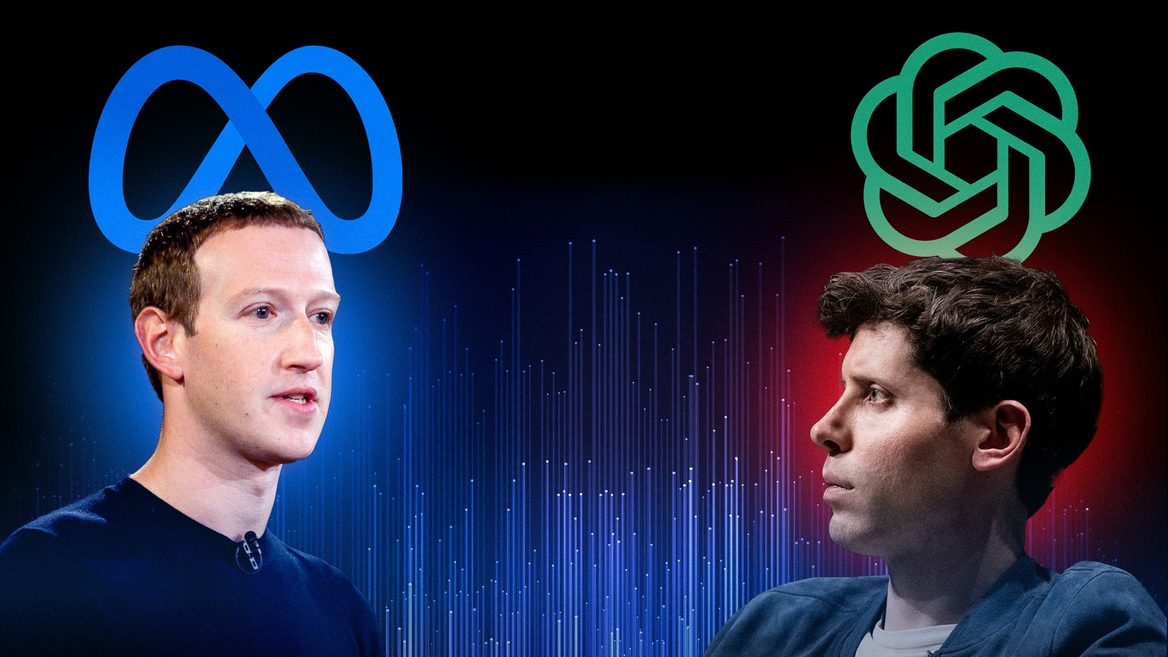
August 2025 marks the beginning of an all-out war between two giants fighting for AI’s future. Industry observers predict this will go beyond simple AI model launch events to become a war for ‘Superintelligence’ dominance that surpasses human intelligence. Meta and OpenAI stand at the center of this fierce competition.
On July 30 (local time), Meta CEO Mark Zuckerberg presented his vision of ‘Personal Superintelligence’ through Threads. This is a concept to make AI a kind of ‘individualized tool’ for enhancing each person’s capabilities.
On the other side stands OpenAI, pursuing Artificial General Intelligence (AGI). OpenAI plans to unveil ‘GPT-5’, the model closest to AGI or superintelligence, in early August. CEO Sam Altman, after directly experiencing GPT-5, emphasized its formidable performance and even expressed being “scared.”
The collision between these two giants, intensifying from August, leads from the technical question of ‘how to create AI that surpasses humans’ to the practical question of ‘what changes will unfold in our lives’. As we enter the superintelligence era that may change humanity’s future, how should we respond?

Meta AI app (Source: Meta)
Meta’s ‘Superintelligence Within Sight’ Bold Move: What is AI for Personal Aspirations?
To understand the competition between Meta and OpenAI, we must first examine the technical visions and roadmaps they present. The future society blueprints drawn by Meta and OpenAI will not only significantly impact the industry but likely become the ‘technological direction’ where hundreds of billions of dollars in capital will be invested over the coming years.
CEO Zuckerberg presented a new direction for AI strategy through a post titled ‘Personal Superintelligence’. The core idea is that AI should become a tool that enhances individual capabilities and improves lives, rather than a force that replaces broad segments of society.
Zuckerberg declared, “Over the past few months, we’ve started to see our AI systems beginning to improve themselves,” adding, “superintelligence development is now within sight.”
This aligns with Safe Superintelligence (SSI) co-founder Ilya Sutskever’s prediction that “when AI starts creating the next generation of AI, an ‘intelligence explosion’ will occur.” This indicates confirmation of signs of self-improving AI, or ‘Recursive Self-Improvement (RSI)’.
Self-improving AI is considered a key to the journey toward superintelligence and AGI in the industry. This was also a statement revealing Meta’s confidence as it recently established a separate superintelligence research institute, ‘Superintelligence Labs’, to accelerate superintelligence development.

Research model applying Darwinian methods to ‘Goedel Machine,’ an AI that rewrites and improves its own code (Source: Sakana.ai)
The section mentioning Meta’s pursued goals is also intriguing. Zuckerberg stated, “Meta’s vision is to provide personal superintelligence to everyone, enabling each person to use it meaningfully in their own lives,” adding, “This differs from those who believe superintelligence should automate all valuable work and humanity should receive some portion of the results.”
This specifically criticized Sam Altman’s philosophy of distributing some AI-created value as Universal Basic Income (UBI) or Universal Basic Wealth in preparation for superintelligence introduction and resulting workforce displacement. By emphasizing that individuals pursuing their own aspirations is Meta’s vision, he made OpenAI’s philosophy appear centralized and controlled.
This vision isn’t a metaphysical declaration. It deeply integrates with Meta’s hardware strategy, particularly smart glasses. CEO Zuckerberg said, “In the future, personal devices like smart glasses will become the primary computing devices,” adding, “these devices will see what we see, hear what we hear, and interact with us throughout the day.”
This presents personalized personal superintelligence as a tool that gathers data from users’ closest proximity, perfectly understands context, and helps achieve goals. This reveals Meta’s powerful ambition to embed superintelligence in smart glasses and dominate the future device platform after smartphones.

Kylian Mbappé, a French professional footballer for Real Madrid CF, is wearing Oakley Meta Glasses. These are smart glasses that combine Oakley’s design with Meta’s AI technology. (Source: Meta)
Integrated Reasoning Capabilities + Router Architecture: Eyes on GPT-5
Industry attention is also focused on OpenAI’s GPT-5, predicted to be unveiled in early August.
This is due to expectations that it will elevate AI performance itself to another dimension. GPT-5 has reportedly completed model training and is currently undergoing safety testing. The Information reported initial reactions from people who used unreleased versions, stating that “the most notable improvements were made in software engineering.”
GPT-5’s core lies in integrating OpenAI’s separately developed reasoning model o-series, particularly the most powerful o3 model. This means GPT-5 will evolve beyond a simple language model into reasoning-type AI equipped with complex logical thinking and multi-step problem-solving capabilities.
While previous models added reasoning functions to language capabilities, GPT-5’s biggest difference is being an integrated model with inherent reasoning capabilities from the start. The Information explained, “Like Anthropic’s hybrid Claude model, users can control how much GPT-5 thinks about specific problems. They can turn reasoning functions on or off depending on how difficult the problem is.”

OpenAI Model Release Roadmap (Source: Sam Altman, Peter Gostev)
Some observers suggest GPT-5 may introduce ‘Router’ architecture. This concept automatically selects the most suitable internal model—reasoning, non-reasoning, tool usage, etc.—based on the user’s prompt characteristics to process tasks. This suggests GPT-5 can function as an ‘AI agent’ that autonomously performs complex tasks.
This means the user experience will change to conversing with an agent without needing to worry about which model to choose. AI agents can understand user intentions from simple prompts, act autonomously, and use tools to present optimal results.
According to information leaked through social media including X, GPT-5 is expected to provide multimodal performance that integrates text, images, audio, and video; problem-solving capabilities with 85% accuracy on difficult coding problems; and a vast context window of up to 200,000 tokens.
Agents capable of autonomously performing complex tasks are an important stepping stone toward OpenAI’s pursued AGI, or superintelligence. Technology with potential to partially replace humans, beyond merely assisting them, is emerging in earnest.
Ultimately, competition between Meta and OpenAI is expected to take the form of a future war to build dominant computing platforms. Meta will emphasize personal superintelligence operating on hardware like smart glasses, while OpenAI will differentiate by emphasizing its role as an AI platform supplying AI model and agent performance to many applications.

Insight Bridge AI’s Perspective: National and Corporate AX Strategy Urgent
What will happen when the superintelligence era becomes reality? CEO Altman compared the fear he felt while testing GPT-5 to the ‘Manhattan Project’, revealing he thought “‘What have we done?'” He likened GPT-5 to nuclear weapon development capable of destroying humanity.
While this could be seen as marketing to emphasize powerful performance, it was also a statement heightening concerns about the destructive power and uncontrollability that superintelligence will bring. He went further to criticize the absence of AI governance, mentioning that “there are no adults in the room.” This serves as a warning that current policy and regulation cannot keep up with AI technology development speed at all.
He also raised serious privacy issues by pointing out the complete absence of legal protection for extremely private conversations users have with AI. Altman noted, “People share their most personal life stories with ChatGPT. There are no (legal) solutions for this yet.”
Industrial impact is also expected to be significant. If GPT-5 gains clear advantages in practical coding work, this could greatly change industry landscape. AI coding services like Microsoft Copilot, Cursor, and Windsurf could be impacted.
AI-powered live coding is already emerging as mainstream in Silicon Valley. Google CEO Sundar Pichai mentioned that 25% of new code within Google is generated by AI, and Microsoft CEO Satya Nadella also stated that about 30% is created by AI.
While these changes maximize corporate efficiency, they can simultaneously cause labor market instability. Concerns arise that junior developer roles could be reduced or replaced, and overall wage growth pressure could be restrained.
Ultimately, superintelligence like GPT-5 will likely function as ‘General-Purpose Technology’ that permeates society overall, like electricity or the internet. Experts observe that labor market restructuring will occur where value shifts to the ability to direct and utilize AI agents.

(Source: Gemini 2.5)
Meta’s personal superintelligence will fundamentally transform the advertising business. Zuckerberg has stated that Meta supports advertisers using AI to completely create and target advertisements on Meta platforms. Highly advanced AI-based marketing can be conducted based on data acquired through smart glasses.
The entire process from image and ad copy generation to potential customer selection and budget allocation will be automated, enabling ultra-personalized ad delivery that dynamically changes advertisement images or messages according to context like user location, behavior patterns, and interests.
Is it wise to entrust more responsibilities to faster and smarter superintelligence? GPT-5 launch and superintelligence emergence may raise ethical dilemmas and responsibility issues. Concerns also arise that specific companies monopolizing powerful superintelligence and concentrating control among a few could pose serious threats. Waves of intense debate about AI regulation, safety, and governance will clearly arrive.
Individuals must move toward maximizing their value by utilizing AI. Since inevitable labor market upheaval cannot be avoided, the wisest response is to use it as an opportunity. We must utilize AI as a tool to augment human intelligence and learn methods to improve productivity. Efforts are needed to automate routine tasks with AI and strengthen soft skills that are uniquely human domains.
Companies need to recreate entire organizations and workflows centered on AI, redesigning business processes. Since AI model performance depends on data quality and quantity, strategies are required to build AI services by maximally utilizing unique data that only our company possesses. In other words, comprehensive AI Transformation (AX) is needed at this point.
Securing talent and retraining existing employees to have capabilities suited to the AI era will also become increasingly important.
See more insightful news!
