[CES 2026 Strategy Series] Robotaxis Move Beyond Tech Demos Into Real Operations
CES 2026 wasn’t just a tech showcase. With over 4,100 exhibitors and 148,000 attendees, it became a compressed preview of the AI Convergence reshaping global industries through 2030.
The most critical shift? AI is no longer optional—it’s the baseline assumption across every sector. Last year, AI was a differentiator. This year, healthcare, automotive, energy, and manufacturing all started with AI as the foundation and asked: “What do we build on top?”
Insight Bridge AI distills the seismic changes witnessed on the CES floor into strategic trends that will restructure the global industrial landscape by 2030.
From Vehicles to AI Computing Platforms
The most striking aspect of CES 2026’s mobility pavilion was what wasn’t there: flashy car unveilings and EV spec wars took a back seat.
Instead, every major automaker spoke the same language: autonomous driving, AI, software, and computing architecture. For the first time, the entire West Hall operated on the assumption that SDV (Software Defined Vehicle) is the new baseline.
This shift reflects changing consumer expectations. After Tesla’s mass-market penetration, buyers care less about fuel type and more about capabilities. As robotaxis transport real passengers through San Francisco and Las Vegas, the entire “ride experience” is being redefined.
Vehicles have become intelligent physical systems. The question is no longer about horsepower—it’s about perception, decision-making, and continuous software expandability. Cars are now AI computing platforms on wheels.
The Competition Changed in Just One Year
The most dramatic transformation at CES 2026 was the shift in competitive dynamics. Previously, success meant “building one great car”—engine performance, fuel efficiency, design, and build quality.
Now, even before reaching full autonomy, the race encompasses driver assistance, safety systems, in-car entertainment, and the entire user experience. Camera-radar-LiDAR sensor fusion, edge computing-based AI inference, on-device generative AI, and vehicle data services are converging into unified systems.
The most important announcement didn’t come from an automaker—it came from NVIDIA.
NVIDIA unveiled its next-generation AI computing model (AlphaMayo), positioning itself as the standard supplier of in-vehicle AI stacks for Level 4 autonomy. The message is clear: control of the automotive industry is shifting from OEMs to whoever controls the computing platform.

NVIDIA’s announced robotaxi platform ‘AlphaMayo’ and its application by Mercedes-Benz (Source: NVIDIA)
Revenue Models Transform Fundamentally
This evolution is restructuring automotive revenue models at their core. Traditional automakers made money from one-time sales. In the SDV era, recurring subscription revenue becomes paramount.
Tesla already proved this model: OTA updates deliver new features that can be monetized continuously. BMW even attempted to subscription-ize hardware features like heated seats (later withdrawn after consumer backlash), but the direction is unmistakable.
Battery management follows the same trajectory. LG Energy Solution’s “Better.Re” system analyzes battery health using 1.2 billion kilometers of real-world driving data, slowing degradation through software optimization. Batteries are no longer mere storage devices—they’re operational assets optimized through data and software.
This signals battery manufacturers transitioning from parts suppliers to “battery lifecycle management service” providers.
BMW Shows the Path Forward
At CES 2026, virtually every SDV showcase and digital cockpit integrated AI functionality. But AI has moved beyond feature demos—it’s becoming the multimodal interface connecting driver, passengers, vehicle, and environment.
BMW’s iX3 announcement crystallized this transformation. BMW didn’t emphasize electric specs—it declared a redefinition of vehicle experience through SDV-based next-gen cockpits integrating displays, voice AI, and OS/apps.
Through Amazon partnership, BMW embedded Alexa-based AI assistants, enabling natural language vehicle operation and feature control. The Panoramic iDrive cockpit system and BMW Operating System X deliver information aligned with driver sightlines while expanding entertainment and app experiences.
The declaration: vehicles are no longer transportation—they’re updateable “computing products.”

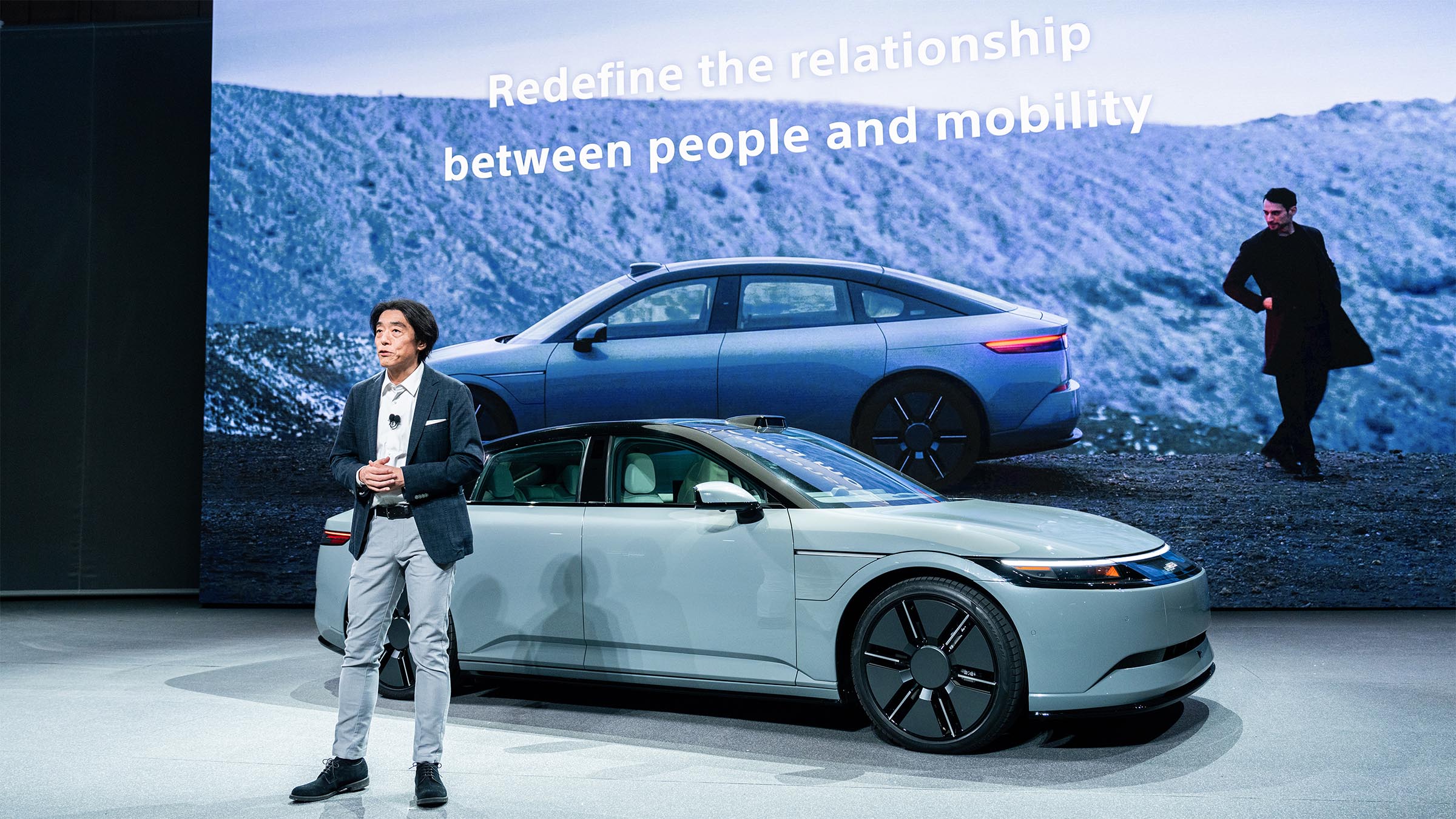
Sony Honda Mobility exhibition defining mobility (automobiles) as entertainment devices (Source: on-site reporter)
Robotaxis: From Technology Showcase to Operations Competition
The most dramatic shift at CES 2026 appeared in robotaxis. Last year, Waymo and Zoox focused on proving “robotaxis can drive on roads.” This year was completely different: “How reliably and cost-effectively can we operate?”
This reveals robotaxis aren’t individual products (single cars) but fleet-based services where utilization rates and customer experience determine success—not individual vehicle performance.
Intriguingly, Waymo showcased no new autonomous technology or vehicles at CES 2026. The 6th-generation fleet—Ioniq-based Waymo and Zeekr RT vehicles—were unveiled last year. Instead, Waymo’s message centered on operational stability, safety processes, and regulatory compliance. The goal: convince audiences that robotaxis are already operating systems transporting real passengers in real cities—not future tech.
Zoox differentiated with a different approach. While Waymo retrofits existing vehicles with autonomy, Zoox designed purpose-built robotaxis with no steering wheel or pedals from inception. The core message: passenger experience, safety, and operations optimized as one integrated system.
Zoox emphasized 360-degree sensing-based unified systems and dedicated vehicles without steering mechanisms, highlighting omnidirectional perception capabilities.

Waymo’s 5th-generation robotaxi exhibited at CES 2026 West Hall (Source: on-site reporter)
The Wrong Question: “Will Robotaxis Happen?”
Waymo and Zoox’s CES 2026 presence signals a fundamental shift in autonomous driving competition dynamics.
“Vision versus radar/LiDAR?” No longer relevant. “Algorithm precision?” Same story. Why? Because they’re already charging passengers on real roads. From consumers’ perspective, what matters is who centers safety and accountability while delivering stable service.
Robotaxi competition isn’t about autonomous technology or performance—it’s about comprehensive ecosystems. Vehicle platforms, autonomous software, computing sensor stacks, dispatch/operations platforms, maintenance and charging infrastructure—the entire integrated system is the competitive unit.
Waymo and Zoox demonstrated they’re accumulating service operations capabilities through different ecosystem approaches.
Robotaxis are fleet-based services, not individual products. Utilization rates and customer experience outweigh individual vehicle performance. The real competitive question isn’t “Will robotaxis happen?” but “Who will standardize repeatable city expansion operations first?“
Strategic Imperatives for Emerging Markets
The transformation witnessed at CES 2026 carries profound implications for emerging automotive markets—especially India.
While traditional automakers maintain global sales positions, they lag in software capabilities compared to Tesla and Chinese newcomers. India faces similar challenges but holds unique advantages.
Three strategic directions emerge:
1. Build Vehicle OS and Software Platform Ecosystems
India needs fundamental ecosystem-level investment in vehicle OS and software platforms. While domestic automakers develop integrated infotainment systems, they lack the ecosystem strength of Google’s Android Automotive or Apple’s CarPlay.
India requires strategic alliances, not domestic competition, to build scale and operational experience for globalization. Automotive companies must collaborate with platform players to create India-specific vehicle OS ecosystems. Integrating services like navigation, music streaming, and payments naturally, then expanding to Southeast Asian markets.
2. Create Integrated Battery-Charging-Energy Management Solutions
India possesses battery manufacturers and charging infrastructure operators. These should integrate into complete “EV energy ecosystems”—managing everything from home charging to route optimization, optimal charging station recommendations, and V2G (Vehicle-to-Grid) energy sales through unified platforms.
This requires industry consortium-level initiatives, not individual company efforts.
3. Develop Robotaxi Industry as National Strategy
CES 2026’s critical lesson: the question shifted from “Will robotaxis work?” to “How do we operate them?” As robotaxis scale, entirely new job categories and industries will emerge.
Fleet Management and Specialized Maintenance Industries will be born. Robotaxis target 24/7 operation, creating maintenance demands far exceeding conventional vehicles. Unit economics and TCO (Total Cost of Ownership) management become critical.
This creates demand for:
- LiDAR, radar, and camera calibration/maintenance specialists
- Rapid cleaning and quick-service technicians maximizing utilization rates
- Predictive maintenance analysts minimizing downtime through data analysis
Remote Operations and Control Centers remain essential even with full autonomy. Unexpected edge cases require human intervention:
- Remote operators handling construction zones or complex intersections
- Integrated control center staff monitoring city-wide robotaxi flows and responding to incidents
In-Vehicle Services and Content Creation emerges as passengers convert travel time into consumption time. Sony Honda Mobility’s “Afeela” demonstrates this: travel-optimized short-form content, movies, and games create new creative job categories. Location-based targeted marketing specialists will analyze routes and preferences to deliver nearby store coupons or enable in-transit shopping.

Zoox exhibited at the LVCC West Hall. It was a popular exhibit that attracted many visitors. (Source: on-site reporter)
India’s Critical Window of Opportunity
Until now, India has viewed autonomous driving purely through a “technology development” lens, blocking progress with safety-focused regulations. But CES 2026’s most important global trend confirms: robotaxis have entered the operations industry phase.
As Waymo and Zoox demonstrate, robotaxis don’t eliminate driving jobs—they transform them into higher-value positions: control center operations, precision maintenance, data management, and in-vehicle service planning.
Smart cities like GIFT City, Navi Mumbai, or planned urban developments could expand Level 4 autonomous testing zones. Data and experience accumulated domestically could export globally—packaging Indian autonomous systems for Middle Eastern or Southeast Asian new city projects.
But if India hesitates, these invisible opportunities vanish. Instead, India risks becoming a hardware supply base operating under OS platforms built by Google, NVIDIA, Amazon, and OpenAI.
Indian companies possess robotics and AI capabilities. Losing this massive job creation opportunity due to regulatory restrictions and insufficient testing infrastructure would be a strategic failure. The time to act is now.
The Insight Bridge AI Perspective: CES 2026 proved mobility leadership no longer belongs to whoever builds the best car—it belongs to whoever operates the best fleet. The atoms-to-algorithms transformation is complete. India must choose: lead the operations revolution or supply components for someone else’s platform.
See more insightful news!
- “https://insightbridgeai.com/beyond-software-5-ai-infrastructure-trends-that-will-define-2026/”
- “Oracle’s AI Revolution: The 36% Surge That Changed Everything”
- “China’s Global AI Ambition: The Shocking Strategy Behind Its New Action Plan”
- “Decoding the Fed’s Warning: How $1.1 Trillion in Margin Debt Threatens Your Portfolio”
- “Exclusive: Google Pixel 10’s Hyper-Personalized AI Stuns Jimmy Fallon”
