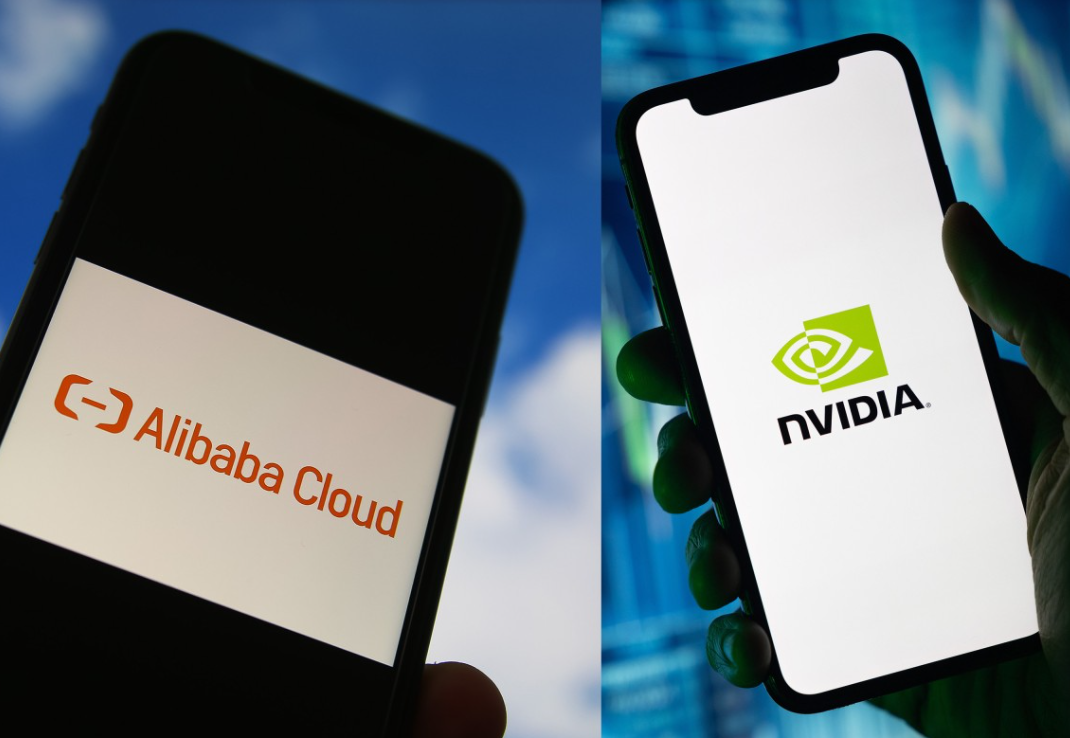
Alibaba’s stock surges on news of H20-alternative AI chip launch… NVIDIA falls.
China’s accelerating semiconductor rise… effects of concentrated government investment.
Huawei’s Ascend chip emerges as leading player… but gaps remain.
Alibaba, Baidu, Tencent, MetaX… the era of warring states begins.
Insight Bridge AI’s perspective: The age of two technology blocs… the race against time begins.
‘Alibaba up 12.9%, NVIDIA down 3.3%’
China’s Accelerating Semiconductor Rise… Effects of Concentrated Government Investment
The U.S. semiconductor export controls targeting China that began in earnest in 2019 have paradoxically served as a catalyst. These controls are driving the Chinese government and companies to pour all their resources into semiconductor localization.
The Center for Strategic and International Studies (CSIS) warned in a 2022 report. They stated that export controls could reduce U.S. companies’ revenues in the Chinese market. This would lead to decreased R&D and investment. Ultimately, this undermines the competitiveness of the U.S. semiconductor industry. The analysis specifically predicted that China would ban U.S.-made chips domestically and attempt technological self-reliance. This would be achieved through investment and innovation in its domestic semiconductor sector.
Indeed, China responded to U.S. export controls in 2022 by banning Micron memory chips from sale in China. This resulted in a 49% plunge in Micron’s revenues for fiscal year 2023.
China’s semiconductor rise has intensified recently. The government has aggressively expanded the investment scale of its “semiconductor big fund” to foster the domestic ecosystem. In response to U.S. sanctions focusing on cutting-edge processes, China has concentrated investments in relatively lower-tech processes (28nm and above). This aims to rapidly expand its ecosystem.
On August 29 (local time), U.S. stock markets saw stark divergence between American semiconductor giant NVIDIA and Chinese tech leader Alibaba. Experts analyze this as market reaction to intensifying moves by Chinese companies. They aim to break free from NVIDIA’s shadow, which virtually monopolizes the global AI semiconductor market.
According to the Wall Street Journal (WSJ), China’s largest cloud company Alibaba is accelerating its own AI chip development. This is to reduce dependence on NVIDIA. The Information reported that promising Chinese AI startup DeepSeek has decided to adopt Huawei’s “Ascend” chips for training and inference of its AI models.
These moves are not independent choices by individual companies. They represent China’s inevitable struggle toward technological self-reliance amid U.S.-China AI hegemony competition. Additionally, America’s strong semiconductor export controls play a role. Observers suggest that movements to switch to domestically-produced chips may spread further. These chips can ensure stable, large-scale supply for business continuity.

Huawei Ascend 920 AI GPU (Source: Huawei)
Huawei’s Ascend Chip Emerges as Leading Player… But Gaps Remain
As U.S.-China hegemony competition and trade sanctions continue, China’s advanced semiconductor capabilities are rapidly developing. Huawei’s AI chip “Ascend” series, developed by the company targeted by regulations, is quickly filling NVIDIA’s void. It is emerging as the center of China’s AI industry.
The Ascend 910B, launched in 2023, is evaluated as delivering performance similar to NVIDIA’s previous-generation flagship A100 chip. This has drawn large-scale adoption from Chinese tech giants like Baidu and Tencent. Huawei hasn’t stopped there, successively developing the performance-enhanced Ascend 910C and next-generation 910D chip. These directly target the H100, rapidly closing the technology gap.
However, industry consensus suggests barriers still exist. A representative case is DeepSeek’s difficulties when using Ascend chips to train its next-generation AI model R2. They encounter problems with relatively immature software support (CANN toolkit), slow connection speeds, and unstable performance.
Particularly, building a platform to replace NVIDIA’s software platform “CUDA” ecosystem, accumulated over 20 years, is no easy task. This becomes a factor that differentiates the theoretical performance hardware possesses from the “practical performance” capable of stably training actual AI models.
Ultimately, DeepSeek adopted a dual strategy. They use Huawei chips for relatively less demanding inference tasks. Meanwhile, they return to NVIDIA’s China-export chip “H20” for training tasks requiring massive computation and stability.

NVIDIA Regional Revenue Share (Source: Bullfincher)
Alibaba, Baidu, Tencent, MetaX… The Era of Warring States
The crucial point is that Chinese companies’ AI semiconductor self-reliance movements are occurring across all fronts. While Huawei emerged first, tech giants like Alibaba, Baidu, and Tencent, along with promising Chinese startups, quickly joined in. As China’s AI semiconductor industry enters an era of warring states, faster technological progress is underway.
Among these, the movements of Alibaba, China’s largest cloud service company, deserve particular attention. This mirrors similar moves by U.S. hyperscalers AWS, Microsoft, and Google, who are all developing their own AI semiconductors.
Alibaba has no choice but to actively pursue its own AI chip development. This is due to its strong objectives of reducing cloud infrastructure costs and stabilizing supply chains. Considering that large cloud companies are core customers of AI semiconductors, the impact on AI semiconductor companies is expected to be significant. Alibaba has long been one of NVIDIA’s biggest customers. According to WSJ, Alibaba’s recently developed new chip focuses on replacing NVIDIA’s H20.
China’s largest search engine company Baidu has also developed “Kunlun” chips optimized for its proprietary AI development framework “PaddlePaddle” and large language model “ERNIE Bot.” Tencent is taking a practical approach by developing semiconductors specialized for its core services, including AI inference chip “Zixiao” and video processing chip “Canghai.”
Shanghai-based MetaX has drawn attention by launching high-performance chips that can directly replace NVIDIA’s H20. Moreover, Moore Threads is building technical capabilities by targeting the gaming GPU market, with startups beginning to distinguish themselves.

NVIDIA’s GPU Platform ‘Blackwell’ (Source: GTC2024)
Insight Bridge AI’s Perspective: The Age of Two Technology Blocs… The Race Against Time Begins
China’s AI semiconductor self-reliance heralds a tectonic shift that will fundamentally transform the global industry landscape. Korea’s semiconductor industry faces the challenge of actively responding to these changes and proactively seeking opportunities.
Expected changes include:
① NVIDIA’s declining China revenues. China accounts for 13% of NVIDIA’s total revenue as of fiscal year 2025. Morgan Stanley predicts China’s AI chip self-sufficiency rate will reach 82% by 2027, up from 34% in 2024. As China’s self-sufficiency rate rises, impact on NVIDIA’s revenues will be inevitable.
② U.S.-China technology hegemony competition signifies the dawn of a “two technology blocs” era. This could pose serious threats to Korea’s AI fabless (semiconductor design) companies. Competing on price and performance with Chinese companies backed by huge domestic markets and massive government support won’t be easy.
China is even pursuing self-reliance in High Bandwidth Memory (HBM), a core component of AI chips. This raises warnings that Korea’s current memory semiconductor advantage may not be permanent.
③ China’s AI infrastructure expansion could serve as an opportunity for Korean memory companies like Samsung Electronics and SK Hynix. As China increases its own AI chip production, demand for high-performance HBM to be installed in these chips will explode. There’s a need to maximize revenue generation before Chinese HBM technology achieves self-reliance. They must continue securing technological advantages in core areas. This includes HBM through “ultra-gap technology development.”
Therefore, the “race against time” has already begun. Boldly investing profits earned through current opportunities into next-generation technologies like PIM (Processing-In-Memory) is crucial. This secures new competitive advantages. Industry-academia-research cooperation and national-level support for activating Korea’s domestic AI chip development ecosystem are more urgent than ever.
See more insightful news.
- “Palantir vs AMD Earnings Report… The Watershed Moment of AI Infrastructure Competition”
- “The Reality of 2025’s ‘K-Shaped Recovery’: The Worst Era of Polarization Since the Great Depression”
- “Figma’s IPO: A Game Changer for Design Tech”
- “China’s ‘AI Action Plan’ Emerges… What’s Behind the Emphasis on Global Cooperation?”
- “How to Raise Your Child as an AI Super-Talent Earning $10 Billion?”
