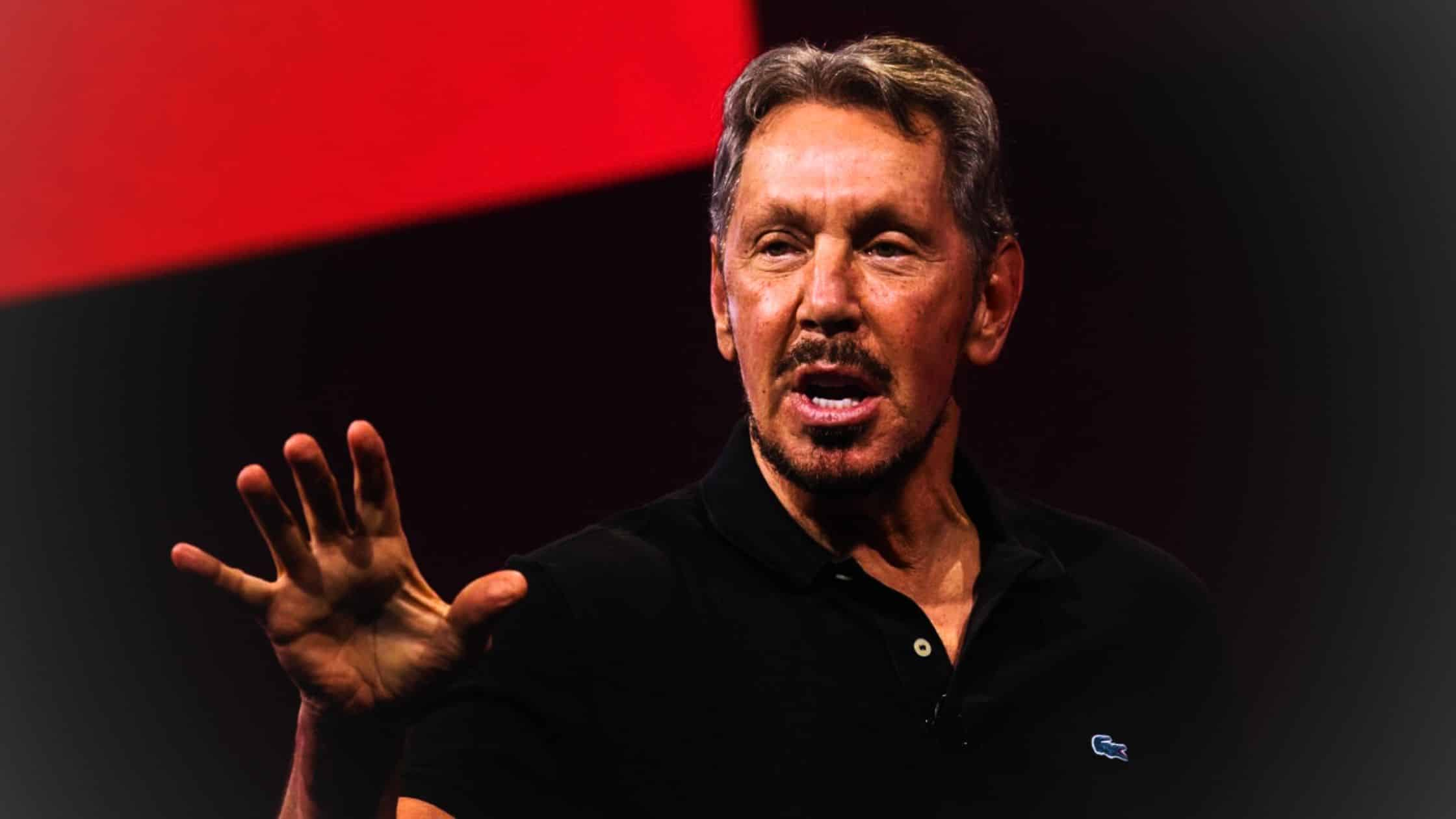
The Genius Musk Admires: How Larry Ellison Became the World’s Richest Man.
From Silicon Valley’s “bad boy” to AI kingmaker – the extraordinary rise of Oracle’s founder.
Musk’s Ultimate Recognition
“Larry Ellison is extremely smart. I can say he’s one of the smartest people I know.”
When Texas Senator Ted Cruz asked Elon Musk to name the smartest person he’d ever met, the answer came without hesitation. Larry Ellison, Oracle’s co-founder, chairman, and Chief Technology Officer.
Musk’s praise wasn’t empty flattery. On September 10, 2025, the world witnessed its meaning in numbers. Oracle’s stock surge pushed the 81-year-old Ellison’s net worth to $393 billion. This briefly surpassed Musk’s $385 billion fortune, making Ellison the world’s richest person.
The shifting fortunes between these tech titans reveal where true power lies in our digital age. Musk drives innovation through Tesla and SpaceX. Meanwhile, Ellison has quietly dominated the invisible backbone of the global economy since founding Oracle in 1977.
Ironically, Ellison’s AI-driven wealth surge included contracts with Musk’s own xAI startup. Rather than being replaced by newcomers, Ellison provides the foundation that enables the new era. This expands his influence even further.
Was the 81-year-old’s brief ascension to number one just luck? How has Silicon Valley’s notorious “bad boy” stayed at technology’s forefront for nearly 50 years?

U.S. President Donald Trump, SoftBank Chairman Masayoshi Son, Oracle Chairman Larry Ellison, and OpenAI CEO Sam Altman announced the Stargate Project. (Source: The Australian)
From Hardship to Silicon Valley Rebel
Larry Ellison’s life story can be summarized in one word: proof. His career began not with privilege, but with deprivation.
Born in 1944 in the Bronx to a 19-year-old unwed mother, Ellison faced early struggles. At nine months old, severe pneumonia nearly killed him. His mother then sent him to Chicago relatives for adoption.
He formed deep bonds with his adoptive mother. However, his relationship with his adoptive father was turbulent. The man repeatedly told young Larry, “You’ll never amount to anything.” These crushing words became fuel for Ellison’s lifelong drive to prove his worth.
Despite gaining admission to prestigious universities – the University of Illinois and the University of Chicago – Ellison dropped out of both. His adoptive mother’s death during his Illinois years particularly devastated him. He abandoned his studies and headed west to Berkeley, California.
For the next decade, he drifted between companies. During this time, he taught himself computer programming. This nomadic period was building toward something greater.
The Oracle Origin Story
1977 marked Ellison’s turning point. He co-founded Software Development Laboratories (SDL) with colleagues Bob Miner and Ed Oates. Their first customer was the Central Intelligence Agency.
The CIA’s database project carried the codename “Oracle.” This name would later become their company identity. Oracle commercialized relational database technology and grew rapidly.
However, success didn’t come without setbacks. In 1990, Oracle faced its greatest crisis. Ellison’s aggressive sales culture backfired spectacularly.
The sales team inflated numbers by counting unpaid contracts as revenue. When this accounting scandal emerged, Oracle’s stock crashed. Investors filed lawsuits. The company teetered on bankruptcy’s edge. The board even considered firing founder Ellison.
This crisis taught Ellison a fundamental lesson about control. He realized that vision alone couldn’t sustain an empire. Only complete control and overwhelming dominance could guarantee survival.
This experience shaped his subsequent management style. His authoritarian approach and aggressive acquisition strategy all stemmed from the 1990 crisis. Never again would he allow such vulnerability.
Emerging from crisis, Ellison began crafting his larger-than-life persona. He competed in America’s Cup yacht races and won. He piloted fighter jets. He built massive estates in Japanese feudal style.
These attention-grabbing activities, combined with his ruthless business methods, earned him the nickname “Silicon Valley’s bad boy.” The struggling youth had transformed into an undeniable giant who played by his own rules.

Oracle Data Center (Source: Oracle)
Philosophy One: Victory or Nothing
“Winning is not enough. Everyone else must lose.”
This quote encapsulates Larry Ellison’s core management philosophy. For him, business wasn’t mere competition – it was total war. He recognized only two options: dominate or be dominated.
This predatory competitive philosophy proved controversial but highly successful in building the Oracle empire.
The PeopleSoft War
Ellison’s philosophy reached its dramatic peak during the 18-month hostile takeover battle for PeopleSoft starting in 2003.
When enterprise software leader PeopleSoft announced its merger with competitor J.D. Edwards in June 2003, Ellison struck back within days. He launched a hostile takeover bid that shocked the market.
What followed resembled a Hollywood thriller. Oracle repeatedly raised its offer to pressure shareholders. PeopleSoft deployed a “poison pill” defense strategy.
The poison pill promised customers software license refunds worth several times their original cost if the company was acquired. This would create massive financial burdens for any acquirer.
The U.S. Department of Justice and European Union intervened, citing monopoly concerns. But Ellison wouldn’t back down. Through relentless legal battles and public relations campaigns, he secured regulatory approval.
Finally, he won over PeopleSoft shareholders. The $10.3 billion acquisition concluded in late 2004. Beyond eliminating a competitor, this battle established Ellison’s reputation: he always gets what he targets.

Philosophy Two: Relentless M&A Strategy
Ellison’s aggression wasn’t limited to specific companies. He eagerly confronted industry giants head-on.
He publicly criticized Microsoft’s monopolistic practices. He even orchestrated the infamous “Trashgate” scandal – hiring private investigators to search trash bins of organizations suspected of receiving secret Microsoft funding.
Ellison compared Bill Gates not to innovator Thomas Edison, but to ruthless monopolist John D. Rockefeller. Their rivalry became legendary.
His competition with German software giant SAP was equally fierce. The PeopleSoft acquisition and subsequent 2005 purchase of CRM leader Siebel Systems both aimed to challenge SAP’s market dominance.
Ellison realized that organic technology development alone couldn’t reshape massive markets. Instead, he chose mergers and acquisitions that destroyed competitive structures entirely. This strategy catapulted Oracle to market leadership almost overnight.
Strategic Acquisition Timeline
This approach continued through major deals:
- BEA Systems (2008): $8.5 billion for enterprise infrastructure software capabilities
- Sun Microsystems (2009): $7.4 billion for core software IP and hardware assets
- NetSuite (2016): $9.3 billion to enter enterprise resource planning markets
- Cerner (2021): $28.3 billion to expand into electronic health records
Each acquisition systematically expanded Oracle’s empire. Rather than simply growing company size, these deals captured key markets and eliminated potential threats.

The Cloud Gambit: Oracle Cloud Infrastructure
For decades, Oracle ruled databases and on-premise software. But cloud computing’s emergence posed an undeniable threat and opportunity.
Amazon Web Services, Microsoft Azure, and Google Cloud rapidly captured market territory. Oracle seemed relegated to “legacy” status, falling behind the new leaders.
However, Ellison threw his own strategic dice in this new battlefield.
The Focused Strategy
As a latecomer, Oracle judged competing in “general-purpose cloud” markets against AWS or Azure as futile. Instead, Ellison focused on Oracle’s greatest strength: high-performance, high-reliability specialized workloads.
This birthed Oracle Cloud Infrastructure (OCI). OCI was designed from inception for ultra-high-performance computing tasks like AI.
Key innovations included:
- Bare metal GPU instances: Direct physical server performance without virtualization layers
- RDMA technology: Remote Direct Memory Access minimizing data transfer delays
- Cluster networking: Ultra-low latency server communication
These features made OCI among the most efficient platforms for AI model training and inference.
Back to DNA
This strategy aligned with Oracle’s fundamental identity. Just as Oracle created relational databases for the CIA’s massive data processing in 1977, providing optimized infrastructure for 21st century AI models embodied Oracle’s core DNA.
Rather than chasing cloud market trends and changing identity, Oracle waited until technology paradigms again required its core competencies. Then it emerged with the perfect tools.
The $300 Billion Validation
This strategy’s validity was proven through history’s largest cloud contract. According to the Wall Street Journal, Oracle signed a five-year, $300 billion cloud computing infrastructure deal with OpenAI, ChatGPT’s creator.
This contract supports OpenAI’s massive AI data center construction project, “Stargate.” The world’s most important AI customer chose Oracle’s technology capabilities.
Wall Street erupted in excitement. Oracle’s stock surged 36% in a single day. Analysts attending Oracle’s earnings call expressed amazement at the historic revenue growth projections.

OCI Architecture (Source: Oracle)
Insight Bridge AI Analysis: Oracle Becomes the AI Arms Race Weapons Dealer
Larry Ellison’s 50-year journey represents Silicon Valley’s history itself. It serves as a vivid textbook on how one visionary builds and maintains an empire across technological waves.
Key Strategic Insights
Resilience and Adaptability: Ellison saved his company from near-bankruptcy in 1990. He then completely transformed Oracle for cloud and AI paradigms. Long-term success requires not just strong starts, but crisis recovery and constant self-reinvention.
Consistent Long-term Vision: Ellison led as CEO and CTO for 45 years. Crucially, he never abandoned his singular vision: “dominate enterprise data markets.” While countless companies struggled through CEO changes and strategic pivots, Ellison’s unwavering focus paid off dramatically in the AI era.
Substance Over Marketing: Ellison always prioritized engineering over marketing, overwhelming product capabilities over flashy packaging. Many consumers don’t recognize Oracle, but no database professional is unfamiliar with it. Ellison believed superior products were the ultimate sales tools.
Calculated Aggression: His career demonstrates that hyper-competitive markets sometimes require ruthless choices. Hostile takeovers and public competitor criticism generated controversy but built and defended his empire. Importantly, this aggression only works with clear vision and overwhelming product superiority.
The New Weapons Dealer
Oracle has evolved beyond a simple software company. It now serves as the essential “weapons dealer” in the global AI arms race.
Major AI companies including OpenAI and xAI have become Oracle customers. By vertically integrating semiconductor chips, data centers, and cloud services, Oracle occupies a unique position. It profits from industry-wide growth regardless of specific AI model success or failure.
The Unfinished Story
One individual’s struggle for self-validation – Larry Ellison’s fight – ultimately reshaped the technology industry landscape. It created a company transcending eras.
Most importantly, his story isn’t finished. As the AI age accelerates, the world watches to see what innovations Ellison and Oracle will deliver next.
The 81-year-old’s brief reign as the world’s richest person sends a clear message. In technology, sustainable power comes not from flashy innovations alone, but from controlling the fundamental infrastructure that enables all innovation.
Larry Ellison didn’t just build a company – he built the invisible foundation supporting our digital future.
See more insightful news!
