America`s July Employment Data Analysis
Trump’s Bureau Chief Dismissal and Employment Data Shock: “250,000 Jobs Have Disappeared”
Data Collapse, Fed Pressure, Recession… Triple Risks Emerge for US Economy Employment figures may also play a crucial role in how these risks develop and are managed.
Insight Bridge AI’s Perspective: US Economy’s ‘Perfect Delusion’ is Now Over… Rally Has Reversed
Trump’s Bureau Chief Dismissal and Employment Data Shock: “250,000 Jobs Have Disappeared”
President Donald Trump announced on August 1st (local time) the sudden dismissal of Bureau of Labor Statistics (BLS) Commissioner Erica McEntarffer. This shocking decision came just hours after the July employment data was released, significantly missing market expectations.
Trump announced on his social media platform Truth Social that he had “just learned that employment data was being produced by Erica McEntarffer, the Labor Statistics Commissioner appointed by Biden.” He stated he dismissed her for accurate statistics.
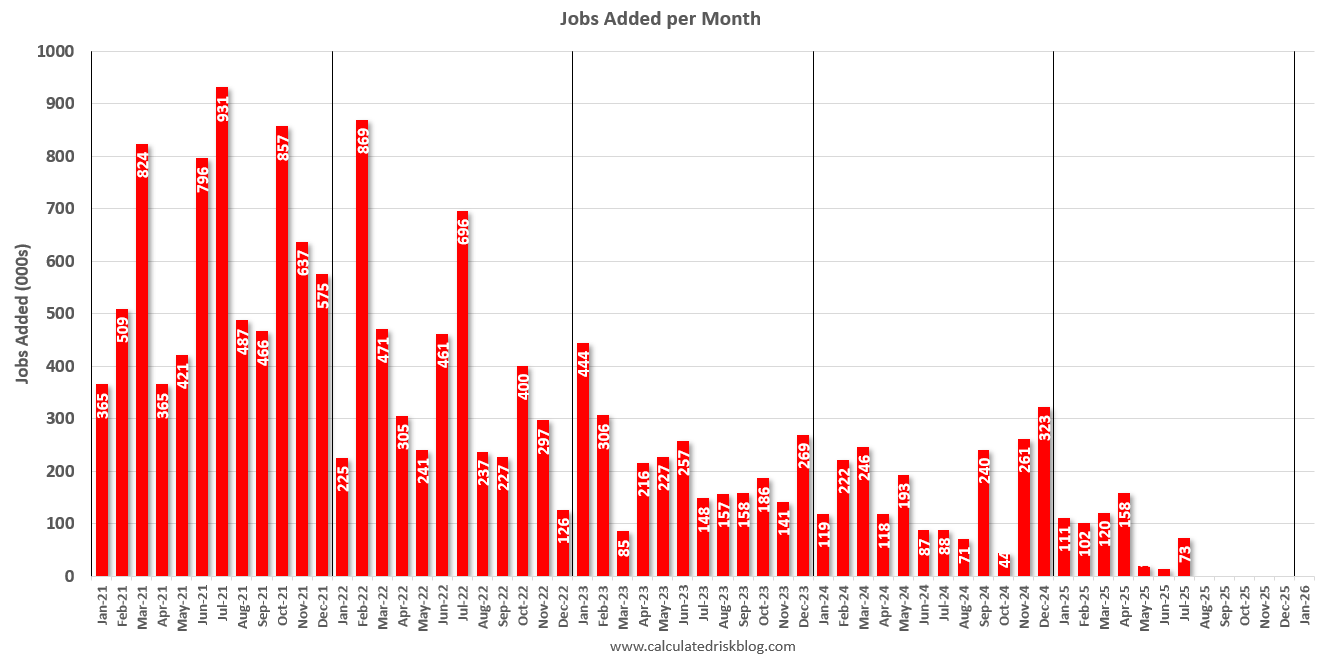
The employment data was indeed shocking. The July non-farm payrolls released by the BLS showed only 73,000 jobs added, significantly below Wall Street’s estimate of 100,000.
More shocking was the fact that May and June figures were revised down by a total of 258,000 jobs. May’s figure was drastically adjusted from the original 272,000 to 19,000, while June’s was revised from 179,000 to 14,000. This represents the largest two-month consecutive downward revision since April 2020, during the early pandemic outbreak.
As a result, the US average monthly job growth over the past three months plummeted to around 35,000. The unemployment rate also rose from 4.1% to 4.2%. Additionally, long-term unemployment (27+ weeks) surged from 1.65 million in June to 1.83 million, raising serious questions about whether the US economy truly stands on solid ground.

The downward revisions from the U.S. Bureau of Labor Statistics (BLS) over the past two months reached 185,000 people. (Source: WSJ)
Data Collapse, Fed Pressure, Recession… Triple Risks Emerge for US Economy
The problem extends beyond the data reliability issues Trump raised to the structural limitations of the US economic statistics system itself. The US Bureau of Labor Statistics relies on surveys from approximately 120,000 businesses and government agencies. They do not use actual payroll processing data like private payroll company ADP. This represents about 26% of total non-farm employment. While the BLS business survey response rate was stable at 60-70% before the pandemic, it has recently dropped significantly below 50%. This fundamentally undermines the reliability of actual figures.
Nevertheless, what’s concerning is the potential politicization of economic statistics. Trump announced an 8% budget cut for the BLS while firing statistical personnel. This not only leads to deteriorating statistical quality, but it also expands the possibility of future governments ‘manipulating’ data in their desired direction.
Simultaneously, he has been launching successive attacks on Fed Chair Jerome Powell, showing the potential to severely undermine the central bank’s independence. This independence has been maintained for over 100 years. When Chair Powell stated after the Federal Open Market Committee (FOMC) regular meeting that he would be “cautious about rate cuts” until the impact of tariffs and inflation becomes clearer, Trump criticized this as a “political game.”
Markets have now begun pricing in not only political uncertainty but also the possibility of recession. Treasury futures markets priced in nearly 90% probability of a September rate cut. Just the day before, this probability was only 37%. Despite the dramatically increased possibility of rate cuts, stock markets plunged. Concerns about recession outweighed expectations of economic recovery from rate cuts.
Even with greater expectations for rate cuts, the S&P 500 fell 1.6% and the Nasdaq dropped nearly 2%. This created the worst decline since April. Meanwhile, preference for safe assets grew, causing Treasury yields to plummet. The 10-year Treasury yield fell a massive 3.8% from the previous day’s 4.382% to close at 4.216%. Additionally, gold futures, recognized as this year’s most representative safe asset, also surged nearly 2% to record $3,413 per ounce.

The reliability of initial data sharply deteriorated as the U.S. Labor Bureau’s initial survey response rate plummeted below 60%. (Source: Bloomberg)
Insight Bridge AI’s Perspective: US Economy’s ‘Perfect Delusion’ is Now Over… Rally Has Reversed
This employment data represents a major event that completely changes the market’s recovery narrative from the second quarter of this year. First, the stock market’s ability to stage a perfect risk-on rally was based on confidence in a strong economy, but that belief is now shaken. Data showing only 30,000 average monthly job growth over the past three months is shocking.
Indeed, Wells Fargo’s senior economist Sarah House noted that “having fewer than half of industries add jobs for three consecutive months is unprecedented outside of recessions.” This essentially suggests that markets may begin reflecting recession possibilities.
Second, the behavior of firing personnel responsible for poor employment data will manifest as weakened confidence in indicators. Peter Mallouk, president and chief investment officer of Creative Planning, criticized: “I can’t believe what I just saw. This cannot happen. A president cannot fire people just because he doesn’t like the numbers.”
The problem is that weakened reliability of economic indicators could structurally increase market volatility. Investors may now need to pay more attention to private alternative indicators (like ADP employment data or Google Trends) rather than traditional analysis relying on government data. This incident isn’t simply a political happening; it could be a warning signal to markets. Both data transparency and central bank independence—core elements of the US economic system—are being simultaneously undermined.
The most serious signal is the continued weakness of the dollar. While the dollar had turned strong recently due to successive trade agreements, it plummeted immediately after the employment data release. This can be seen as a reaction to the US economic slowdown, but it can also be interpreted as concerns about the reliability of government data. Moreover, it suggests damage to central bank independence. Particularly, historically, the fall of hegemonic powers has been based more on institutional trust collapse—like the Roman Empire’s currency devaluation and the British Empire’s pound crisis—rather than military defeats, making this situation require more serious attention.
See more insightful news!
