The New Gold Rush
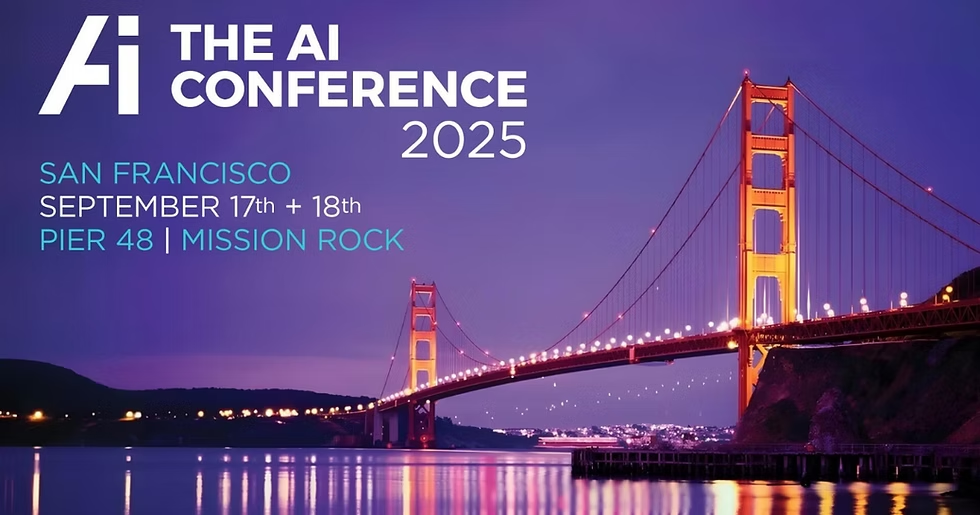
Step inside Pier 48 in San Francisco, and you’re transported to a modern-day gold rush. At this AI Conference, the massive warehouse-style conference hall buzzes with energy. AI startups crowd every corner, hawking their products like prospectors selling claim maps.
CEOs thrust business cards into outstretched hands. Inventors desperately explain their patent ideas. Solo attendees in business casual—some recently laid off—wander with backpacks, hoping to be discovered.
This was the scene at the SF AI Conference in September. Everyone came to sell something or be found.

Dr. Yegor Denisov-Blanch from Stanford University gave a presentation on the topic “Will AI Replace Software Engineers?” (Source: On-site booth).
“We’re Doing AI Too”
The exhibition floor sprawls like a maze. Companies compete for attention with giveaways: tube socks dyed in corporate colors, Ghirardelli chocolates, tiny dolls, Rubik’s cubes, phone chargers, even coconut drinks with straws.
One booth offers AI-enhanced “glamor shots”—complete with rockstar styling options.
The polarization is striking. Half the vendors sell infrastructure and software to add AI agents to business workflows. The other half sells the opposite: guardian agents to monitor and control those AIs.
These products assume AI can spin out of control at any moment.
The Guardrails Industry
“You need guardrails,” says Eby Ramani, VP of Marketing at Trust3 AI, a San Francisco startup. His company provides AI “accountability” platforms for insurers and banks.
The risks are real. AI is unpredictable. It generates false information. It easily violates privacy regulations. Chaos multiplies when employees create their own AI bots without telling management.
“This is the honeymoon period,” Ramani warns calmly. “Reality will hit soon.”
Another company, Markup, reviews and edits AI-generated content to match corporate standards for “tone, quality, and accuracy,” explains CEO Matt Blumberg.
San Mateo startup Nexla specializes in connecting data from different systems—like aggregating multiple restaurant orders into one delivery app.

At the 2025 AI Conference keynote at Pier 48 in San Francisco, Michele Catasta, CEO of AI Replit, and Mark Sullivan, Senior Writer at Fast Company, discussed the future of Agentic AI. (Source: On-site booth)
The 95% Statistic Everyone Quotes
An MIT research paper found that 95% of AI pilot programs fail. Conference attendees couldn’t stop citing this statistic.
“Everyone here keeps quoting that 95% failure rate,” says Amy Lefebvre, Director of Customer Experience at medical technology company AbleNet. She attended with colleagues for educational purposes.
The most popular seminar? “Why Your Organization is Designed to Fail at AI (And What to Do About It).”
The audience craved advice on how to “reposition” companies and “retrain” people whose skills in graphics or programming suddenly became obsolete. The speaker fielded questions for nearly an hour after his presentation ended.
Size Doesn’t Matter Anymore
A year ago, San Francisco’s mood was different. Google, Meta, and OpenAI competed like car manufacturers showing off engine displacement—bragging about parameter counts.
But 2025’s conversation has completely shifted.
The key question isn’t “how big can we build it?” It’s “how do we actually increase revenue and cut costs?”
Salesforce announced it fine-tuned small language models (SLMs) with fewer than one billion parameters to customer data. The result? Dramatically reduced operating costs while maintaining over 95% accuracy.
The new pragmatism: not every task needs a giant model.
Real-World Impact
In finance, AI agents are replacing Bloomberg Terminal data analysis functions that once cost thousands of dollars monthly.
Individual investors can now receive custom reports predicting Nike’s quarterly earnings. AI analyzes competitor data, consumer reviews, and discount rates instantly.
In healthcare, Brainstorm Therapeutics combined brain organoids (mini-brains) with AI to discover drug candidates. The work has already received FDA Phase 2 clinical approval.
AI agents are no longer just tools—they’re teammates. In call centers, they instantly analyze customer records to provide personalized responses. Sales teams cut customer research and meeting prep time by 90%.
Development teams benefit too. When servers crash at midnight, AI analyzes logs and applies temporary patches automatically. Engineers can sleep through the night.
The Wanderers
Among the flashy booths and passionate CEOs, certain people stood out. They looked a bit older, wore plain clothes without logos. They wandered the massive exhibition hall alone, carrying backpacks or free lunch boxes.
Some came out of curiosity. Others hoped to be discovered.

On the first afternoon, AI startups pitched their business models to investors, each given four minutes and only four slides for their presentations. (Source: On-site booth)
The Renaissance Worker Emerges
The conference attracted people applying AI to degenerative brain disease research. It also drew unemployed programmers.
Some seemed lost, drifting from one conference to another. Though strangers, they engaged in lively discussions around lunch tables, water coolers, and booth mazes.
The topics: how much AI could make life easier, and how many people it might leave behind.
AI doesn’t simply replace human roles. It handles repetitive, technical tasks while freeing humans for creative and strategic challenges.
But AI proficiency will determine future competitiveness. Some research warns that by 2030, the productivity gap between top-performing and bottom-performing teams could reach 10x.
A new type of talent is emerging: the “Renaissance worker.” These professionals use AI assistance to maintain core expertise while simultaneously building capabilities in adjacent fields.
Farmers become data scientists. Salespeople transform into analysts. Engineers develop operations expertise.
This isn’t shallow generalist knowledge. It’s a new talent profile combining specialization with versatility—powered by AI as a collaborative partner.
The Undercurrent of Anxiety
San Francisco has experienced a new gold rush since the pandemic. AI conferences and conventions pack the calendar. The SF AI Conference represents this trend.
Wandering the exhibition floor, you see entrepreneurs competing for attention and investment everywhere.
Many participants expressed clear excitement about AI’s future. That was the conference theme, after all.
But no amount of enthusiasm could completely mask the underlying anxiety. Two fears lurked beneath the surface: the ominous prediction that AI will change society irreversibly, and the worry that the AI bubble might burst.

Many AI companies set up booths in the exhibition area to promote their products. (Source: On-site booth)
The Message is Clear
The 2025 San Francisco AI Conference delivered an unambiguous message. The era of showing off giant models is over.
The real competition now: who can connect AI to actual results more safely and intelligently?
AI is already increasing revenue and cutting costs across industries. It’s opening opportunities for humans to focus on creativity and strategic thinking.
But the expressions on faces filling Pier 48’s massive hall weren’t simply optimistic.
They reflected “anxious excitement.”
In a landscape where 95% fail, no one knows for certain whether they’ll land in the 5%—or become another face in the back alley, waiting to be noticed.
That’s the particular tension of gold rush eras.
Lessons for the AI Industry
The implications are clear. Don’t just showcase technological achievements. Develop practical use cases for industry settings and establish trust frameworks.
Winning the global AI competition may require something other than bigger models.
It may demand smarter application.
And at the frontlines of that competition will stand the Renaissance worker—combining deep expertise with broad versatility.
The question everyone’s asking: Are you ready to be part of the 5%?
See more insightful news!
