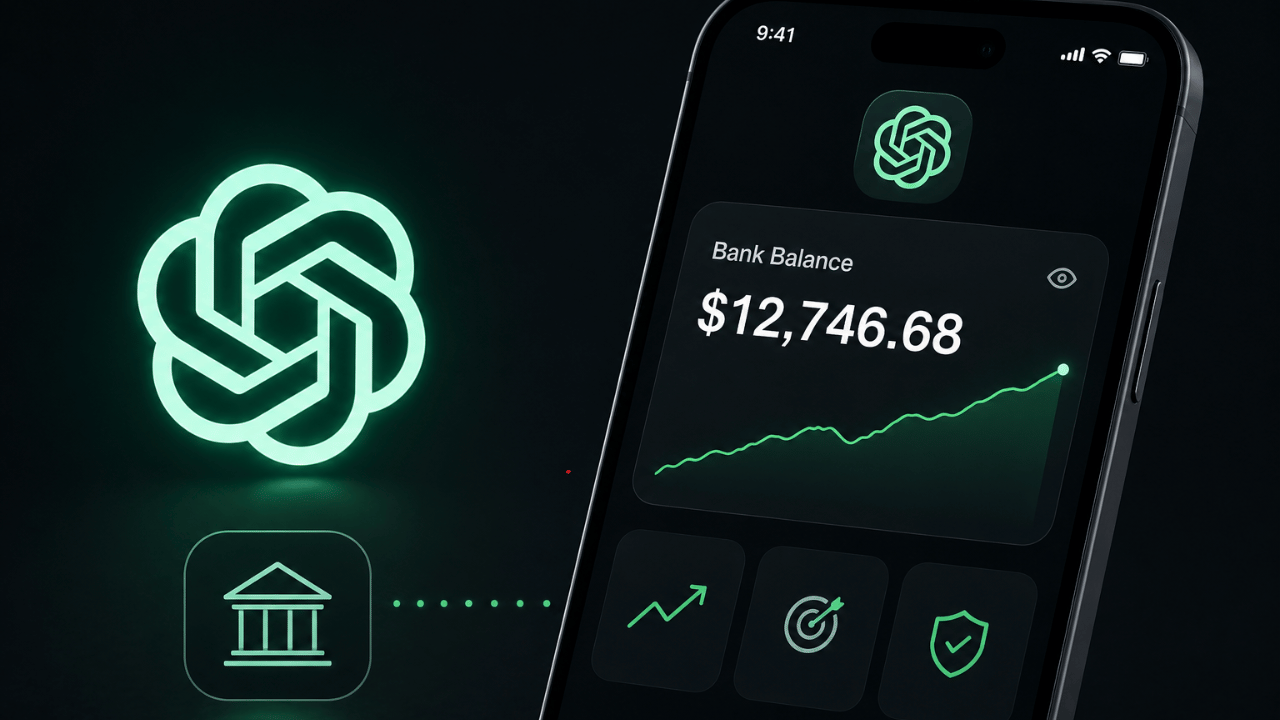
TL;DR: OpenAI just turned ChatGPT into a personal finance brain. It connects to your bank, reads your spending, and plans your house purchase — all in plain English. The fintech world is officially nervous. Emerging markets like India, Indonesia, and Brazil need to pay very close attention.
“Build me a plan to buy a house in this neighborhood within the next five years.”
Type that into ChatGPT now, and it will actually try. Not in the vague “here are 7 generic tips” way we’re used to. In the “I just looked at your Chase account, your Robinhood portfolio, and the suspicious number of DoorDash charges last weekend” way.
On May 15, OpenAI quietly flipped the switch on something it’s calling the Personal Finance Experience — and if you squint, you can see the entire personal finance industry flinching in real time.
What Actually Changed
For Pro subscribers in the US ($200/month, yes, ouch), ChatGPT can now hook directly into your bank and brokerage accounts. Once connected, it builds you a live dashboard: portfolio performance, spending breakdowns, active subscriptions, upcoming bills — the whole financial selfie.
You activate it from the new Finances tab in the sidebar, or by typing @Finances, connect my accounts in any chat. It runs on the GPT-5.5 reasoning model and plugs into more than 12,000 financial institutions, including Chase, Fidelity, Schwab, Capital One, and Robinhood.
The killer feature? You just… talk to it.
“My spending seems higher this month — what changed?” “If I sell these shares, what does it do to my taxes?” “Can I actually afford this car?”
You can also save “financial memories” — things like your mortgage goals, the $3,000 you lent your brother in 2024 (and may never see again), or your monthly savings target. ChatGPT remembers them across conversations.
Coming soon: Intuit integration (TurboTax + Credit Karma), which means tax-impact analysis and credit-approval predictions are about to become casual chat-window questions.
The Plumbing: Plaid Is the Quiet MVP
None of this works without Plaid, the fintech data layer that already powers Venmo, Robinhood, Chime, Coinbase, Betterment, and SoFi.
Here’s the part security folks will appreciate: ChatGPT never sees your banking password. Plaid handles the auth via encrypted, token-based, consent-driven channels. ChatGPT gets to read balances, transactions, holdings, and debts — but it cannot see full account numbers, and it cannot move money between accounts.
A bot that can analyze your bad financial decisions but can’t act on them. Honestly, that might be the most ethical thing in fintech this year.
This Wasn’t Improvised — OpenAI Has Been Loading the Cannon
This launch didn’t appear out of thin air. In April, OpenAI acquired Hiro Finance, an AI-native personal finance startup. Hiro’s CEO Ethan Block is a serial founder who previously sold the auto-savings neobank Digit to Oportun for over $200 million. In October 2025, OpenAI also poached the founding team of personal finance app Roi.
According to OpenAI, over 200 million people per month already ask ChatGPT money-related questions. The pitch is simple: stop answering vague questions with generic advice. Start answering specific questions with your actual data.
As Dylan Lerner, senior digital banking analyst at Javelin Research, put it in American Banker: AI companies are now moving into financial services faster than the banks and fintechs are moving into AI. That sentence should be tattooed on the forehead of every fintech CEO this morning.
“AI Is Coming for the Advice Layer”
Here’s the part the industry quietly fears.
Rudy Yang, fintech analyst at PitchBook, called personal finance “one of the most-discussed use cases since generative AI arrived” — and said the Hiro acquisition confirms exactly where OpenAI is heading.
Paul Schaus, Managing Partner at CCG Catalyst, was blunter: if users start asking ChatGPT for financial advice instead of opening their bank’s PFM tool, banks and fintechs face disintermediation — losing direct contact with their own customers. That’s not a competitor problem. That’s an existential problem.
And OpenAI isn’t alone:
- Anthropic released an AI agent template for financial services on May 5.
- Perplexity launched a computer-agent-driven financial research product earlier this month.
The race to become “the place people go to think about money” is officially on.
The Insight Bridge AI Take: Convenient, Yes. Safe? It Depends.
Letting an AI peek at your bank account is genuinely useful. The question isn’t whether it’s helpful — it’s whether you trust the pipes.
OpenAI’s safeguards on paper look reasonable: disconnect any time, synced data is deleted within 30 days of disconnection, you can wipe stored financial memories, and you can opt out of having your data used for model training.
The catch: the default training setting is still on. If you don’t manually opt out, your conversations about your mortgage and your credit card debt may be used to train future models. Read the toggle. Then read it again.
This also lands while OpenAI is facing a class action in California federal court alleging it embedded Meta Pixel and Google Analytics code that quietly forwarded user queries, account identifiers, and email addresses to Meta and Google. Within minutes of the finance feature going live, that lawsuit was trending again on social media. Bad optics — though not necessarily a bad product.
And then there’s the deeper issue. Andrew Lo, head of MIT Sloan’s Laboratory for Financial Engineering, told PYMNTS the real concern isn’t whether AI is smart enough. It’s that AI does not have fiduciary duty — no legal obligation to act in your best interest. Your human advisor does. Your chatbot doesn’t. Keep that in your back pocket.
The Domino Effect Is Already Visible
When Anthropic launched Claude Cowork in late January — with domain plug-ins for financial analysis, legal research, and sales — the stocks of FactSet, Thomson Reuters, and several financial info incumbents got smacked. Investors saw the writing on the wall.
OpenAI’s launch puts a similar bullseye on:
- Budgeting apps like Mint and YNAB
- Bank-native assistants like Bank of America’s Erica
- Robo-advisors like Personal Capital and Betterment
If a $20/month ChatGPT Plus subscription eventually delivers 80% of what these tools provide, the math gets ugly fast.
What This Means for Emerging Markets
Right now, the Personal Finance Experience is US-only, Pro-tier only. But that’s the launchpad, not the destination. The interesting question is what happens when this hits emerging markets — because the infrastructure picture there is, frankly, more advanced than people in Silicon Valley realize.
India: The Account Aggregator Wildcard
India might actually be the country most prepared for AI-native personal finance — and the most regulated.
The numbers are staggering. The Account Aggregator framework has over 2.6 billion accounts enabled to share data, with 252.9 million users having linked accounts as of December 2025. UPI processed roughly 2,264 crore transactions worth ₹29.53 lakh crore in March 2026 alone. The Reserve Bank of India is rolling out Banking BHASHINI, a domain-specific multilingual AI model covering all 22 scheduled Indian languages, and MuleHunter.AI for fraud detection.
In other words: India already has the rails. Razorpay has even piloted “agentic payments” with NPCI — conversational AI assistants that can discover products, compare options, and complete transactions over UPI.
The challenge isn’t tech. It’s regulation. Any AI offering effective investment advice will need to navigate SEBI’s investment-advisor rules, RBI’s NBFC and AA-participant licensing, and the DPDP Act on consent. The line between “helpful financial chat” and “regulated investment advice” is going to get litigated — hard.
Local players to watch: Jupiter, Cred, Fi Money, and Groww. If they don’t build conversational AI layers fast, ChatGPT will eat their lunch the moment it lands on Indian rails.
Indonesia and Southeast Asia: The Super-App Battleground
Indonesia, the Philippines, and Vietnam don’t have the policy elegance of India’s stack, but they have something just as powerful — super-apps with everything already in one place. GoTo, Grab, and Sea Group already sit on payments, lending, investing, and insurance data for hundreds of millions of users.
If OpenAI shows up here, the war is less about who has the data and more about who has the trust. Bank Indonesia’s QRIS rails and Otoritas Jasa Keuangan’s (OJK) tightening grip on digital lending will shape how — and whether — foreign AI players are allowed to plug in directly.
Expect Grab and GoTo to ship their own conversational financial assistants before ChatGPT ever gets a local license. The race is on.
Brazil: PIX Is the Sleeping Giant
Brazil’s PIX instant-payment system and the country’s Open Finance framework give it infrastructure that genuinely rivals India’s. Nubank alone has over 100 million customers and is already deploying conversational AI inside its app. If ChatGPT launches in Brazil, Nubank’s response will tell us a lot about whether incumbents in EMs can move fast enough.
The Bigger Picture
What’s happening here isn’t really about ChatGPT learning to read your Chase statement. It’s about a much larger transition: the layer where people make financial decisions is moving from apps to conversations.
If that’s true — and I think it clearly is — then the long-term winners won’t be the platforms with the prettiest dashboards. They’ll be the ones whose AI you actually trust to remember your goals, respect your data, and tell you, with a straight face, that no, you cannot afford that boat.
Banks, fintechs, and regulators in emerging markets have a narrow window to prepare. Use it.
See more insightful news!
- “Human API: Why AI Is Now Hiring Humans — Not the Other Way Around”
- “AI’s Big Six Reunite After 40 Years: What They Said About AGI Will Surprise You”
- “Oracle’s AI Revolution: The 36% Surge That Changed Everything”
- “China’s Global AI Ambition: The Shocking Strategy Behind Its New Action Plan”
- “Decoding the Fed’s Warning: How $1.1 Trillion in Margin Debt Threatens Your Portfolio”
- “Exclusive: Google Pixel 10’s Hyper-Personalized AI Stuns Jimmy Fallon”
