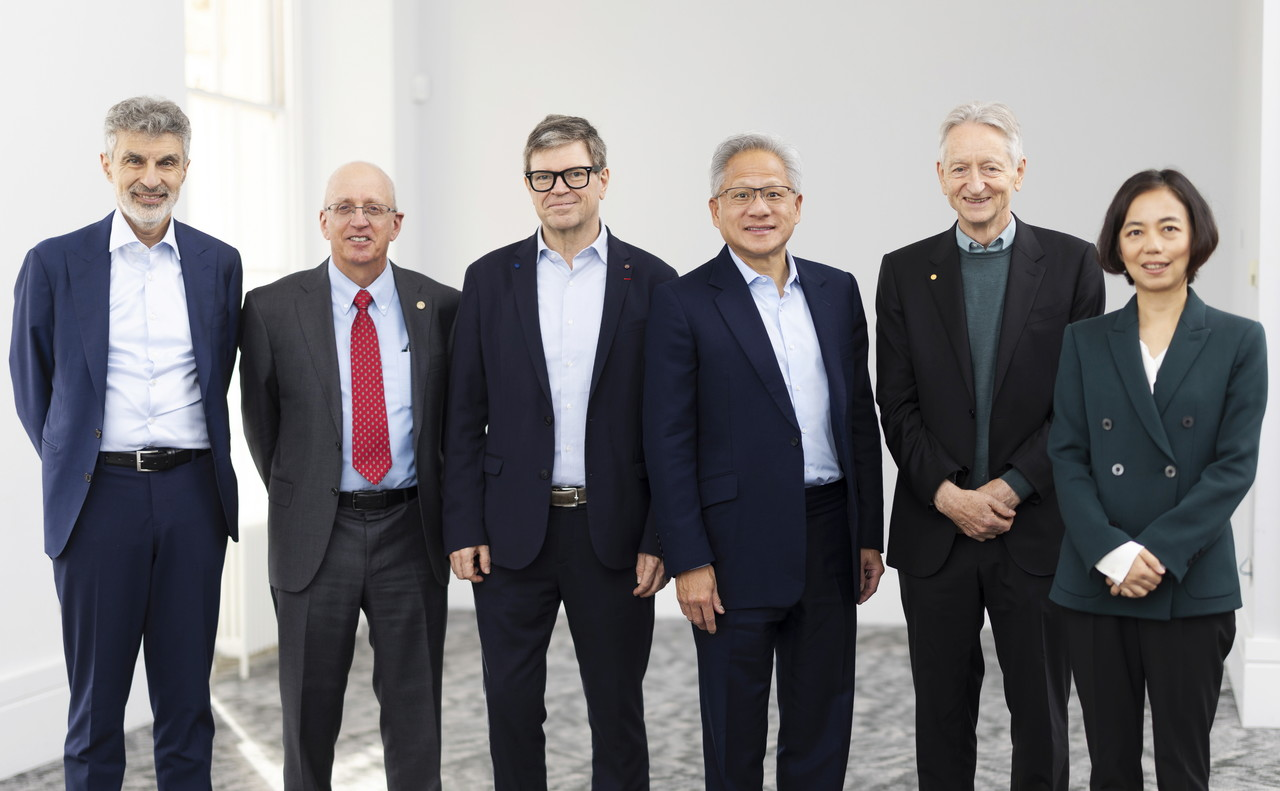
Award recipients (from left): Yoshua Bengio, Bill Dally, Yann LeCun, Jensen Huang, Geoffrey Hinton, and Fei-Fei Li.
Not pictured: John Hopfield (Photo source: Stanford University).
The Queen Elizabeth Prize brought together the minds behind modern AI. Their discussions included topics like AGI, and their answers about superintelligence and market bubbles changed everything.
Geoffrey Hinton, Jensen Huang, Fei-Fei Li, Yann LeCun, Bill Dally, and Yoshua Bengio—the six titans who built artificial intelligence—sat together for the first time on November 6th. They’d just won the 2025 Queen Elizabeth Prize for Engineering. What happened next was historic.
The conversation began with a confession. In 1984, Hinton built a “tiny language model” with just 100 training examples. The core idea? Identical to today’s AI. It took 40 years to realize because of two missing pieces: computing power and data.
Now, the man who built that computing power—Jensen Huang—sat across from him. The scene captured everything about the AI revolution. Algorithm creators meeting the infrastructure builder who made it all real.
Two questions dominated their discussion: When does AGI arrive? And is AI one giant bubble?
Is AI a Bubble? Two Very Different Answers
Jensen Huang was blunt. “Every GPU we’ve sold is turned on and running.” Unlike the dot-com crash, where fiber optic cables sat dark and unused, today’s AI infrastructure works around the clock.
AI isn’t software anymore, Huang argued. It’s real-time intelligence manufacturing. It’s compute-intensive production. Spending hundreds of billions on infrastructure to support a multi-trillion dollar industry? Perfectly rational.
Yann LeCun agreed—partially. “There’s enormous room for LLM applications. The infrastructure investment makes sense.” Then came his warning: “Expecting current paradigms to reach human-level intelligence? That’s the bubble.”
When Does AGI Arrive? Nobody Agrees
Ask six AI legends when artificial general intelligence arrives, get six different answers.
Yoshua Bengio: “It’s not an event. It’s a gradual process.”
Fei-Fei Li: “Machine and human intelligence aren’t even comparable.”
Jensen Huang: “It’s already here. Besides, it’s just an academic question.”
Geoffrey Hinton provided the only concrete timeline: “Twenty years until AI always wins debates.”
Here’s what matters: AGI as a concept dissolved during their conversation. When everyone calls it “not a single event,” AGI becomes unmeasurable. You can’t determine if you’ve achieved what you can’t measure. This isn’t a technical debate—it’s an existential void.
Fei-Fei Li struck the heart of it: “How many humans can recognize 22,000 objects?” Machines already dominate humans in specific domains. Yet as LeCun noted, they don’t understand the world like a cat does. So what are we really asking? Not “when does AGI arrive” but “why do we want AGI to be a single point?”

Professor Geoffrey Hinton of the University of Toronto (Source: Gemini)
Hinton’s Shocking 1984 Revelation
Hinton’s confession stunned the room. His 1984 “small language model” worked on the same basic principles as today’s systems. Convert words to features. Use feature interactions to predict the next word. He couldn’t understand why backpropagation didn’t solve everything. The reason was simple: no computing power, no data.
For 40 years, the algorithm’s core remained unchanged. Only two things evolved: the computing infrastructure Jensen Huang built, and the datasets Fei-Fei Li created. Those two things changed everything.
That’s the essence of technological revolution. Brilliant ideas don’t change the world. Infrastructure that makes ideas executable changes the world.
Here’s the moment Indian readers shouldn’t miss: In 2010, Andrew Ng used 16,000 CPUs to find cats on the internet. Jensen replicated it with 48 GPUs. A 300x efficiency difference. That moment determined NVIDIA’s direction. While algorithm geniuses refined theory for 40 years, the real game-changer came from an engineer asking: “How do we actually run this?”
For India’s rapidly growing AI ecosystem—from Bengaluru’s startups to Chennai’s research labs—this lesson is critical. Infrastructure, not just algorithms, drives breakthrough innovations.
Geoffrey Hinton: 20 Years Until AI Wins Every Debate
“When machines always win debates with humans, that’ll happen within 20 years. If you define that as AGI, then 20 years.”
Geoffrey Hinton pioneered backpropagation in the 1970s-80s when neural network research lived on academia’s fringe. His algorithm enabled deep neural networks to learn complex patterns.
His “aha moment” traces to 1984. Using backpropagation, he experimented with predicting the next word in sequences. Training data? Just 100 examples. This tiny model learned fascinating features about word meaning.
“We lacked computing resources and data back then. It took 40 years to get here.”
That late-1984 “small language model” became today’s large language models. His discovery was simple: when neural networks learn statistical relationships between words, they naturally capture meaning. Backpropagation launched deep learning and reignited dormant neural network research.
In 2012, his students Alex Krizhevsky and Ilya Sutskever dominated ImageNet with AlexNet. Hinton joined Google in 2013, spending the next decade at deep learning’s center. In 2023, he left Google with a stark warning:
“AI systems may soon become smarter than humans. I think this could make us extinct.”
He realized AI “thinks” fundamentally differently from humans. Human brains learn independently. AI models instantly share learned knowledge. If thousands of AIs learn simultaneously and integrate knowledge, they’ll become smarter at speeds humans can’t match.
In October 2024, Hinton won the Nobel Prize in Physics with John Hopfield. His AGI timeline remains specific and unsettling.

Professor Fei-Fei Li of Stanford University (Source: Gemini)
Fei-Fei Li: From ImageNet to Spatial Intelligence
“AI is a very young field—not even 70 years old. Compared to physics with 400+ years of history, there’s far more uncharted territory ahead.”
In 2006, Stanford Assistant Professor Fei-Fei Li faced a puzzle. No matter how much she trained machines, they couldn’t classify everyday objects. Intelligent animals like humans distinguish and categorize objects from early development. ‘Can’t machines learn like humans?’ Through persistent experiments, she reached an answer.
“We need much, much more data.”
Humans don’t need massive data to learn. Machines were data-starved. She found the solution there.
Over three years, she worked with people worldwide. Curating 22,000 categories and 15 million images by hand. ImageNet was born.
“With truly large amounts of data, you can train machines.”
ImageNet transformed AI history. Researchers abandoned self-supervised learning programs to focus on supervised learning. The entire industry and research community reorganized.
In 2018, as Google Cloud’s inaugural Chief AI Scientist, she gained another insight. Serving every industry—healthcare, finance, manufacturing—confirmed AI as a “civilizational technology.” She returned to Stanford to co-found the Human-Centered AI Institute.
Now she focuses on spatial intelligence. “LLMs and agents are language-based. But human intelligence has capabilities beyond language.”
Humans and animals perceive, reason, interact, and create—in ways that far exceed language. “Even today’s most powerful language-based models fail basic spatial intelligence tests.”

Jensen Huang, CEO of Nvidia (Source: Gemini)
Jensen Huang: Intelligence Requires Factories
“AI created an industry requiring factories to produce intelligence. Unprecedented. To serve a multi-trillion dollar industry built on intelligence, you need hundred-billion-dollar factories.”
Jensen Huang’s awakening came in 2010. Researchers from Toronto, NYU, and Stanford simultaneously contacted NVIDIA. He spotted the pattern.
“Deep learning network structures closely resembled chip design. Just as we’d scaled chip design, software development could scale too.”
NVIDIA architecture’s key feature was parallelization. What ran well on one GPU ran well on multiple GPUs, multiple systems, even multiple data centers. “The rest was an engineering problem of how far we could extrapolate this capability.”
On whether AI markets are a bubble, he was definitive. “No bubble.”
His logic was clear. During the dot-com bubble, most deployed fiber optic remained unused—so-called “dark fiber.” Today, nearly every GPU you can find is powered on and in use.
AI fundamentally differs from past software. Old software was pre-compiled. Computing requirements stayed low. AI must perceive situations and generate intelligence in real-time.
Jensen identified two exponential growths driving demand. First, computing needed to generate responses has exploded. Second, AI model usage is growing exponentially.
“We’re at the start of building intelligence. Most people don’t use AI yet. In the future, you’ll interact with AI almost every moment.”
His answer on AGI timing was pragmatic. “We already have sufficient general intelligence. AGI timing is just an academic question. Technology will keep advancing, and we’ll apply it to solve important problems.”

Yann LeCun, Chief Scientist at Meta (Source: Gemini)
Yann LeCun: Self-Supervised Learning Returns
“The future holds much uncertainty. Don’t make claims. Plan according to circumstances.”
Since undergrad, Yann LeCun was captivated by AI and intelligence. What grabbed him was training machines instead of programming them.
“Like how intelligence self-organizes in life, I thought it better to let machines train themselves.”
In 1983 grad school, finding anyone researching this field was hard. He discovered Geoffrey Hinton’s papers and met him in 1985. Two giants meeting. They could predict each other’s next words.
Late 1980s disagreements emerged. LeCun believed only supervised learning was well-established. Hinton argued only unsupervised learning could drive progress. By the mid-2000s, they focused on self-supervised learning with Bengio—having machines discover data structure without specific task training.
Then Fei-Fei Li created ImageNet. Large-scale labeled datasets made supervised learning work far better than expected. Researchers temporarily abandoned self-supervised learning.
But around 2016-2017, researchers realized: “Supervised learning alone won’t get us where we want. We need self-supervised learning.” LLMs became the best example.
His view of current AI markets is dual-layered. “Many application areas can be developed based on LLMs. When smart wearables support everyone’s daily life, the computing required will be enormous.” But there’s a warning. “Thinking the current LLM paradigm will reach human-level intelligence could be a bubble. We don’t even have robots as smart as cats.”
His AGI prediction is concrete yet cautious. “There’s no conceptual reason machines can’t do nearly everything humans can.”
Particularly, AI’s ability to conduct AI research and design next-generation AI is advancing rapidly. LeCun’s once-negative AGI predictions no longer define conceptual limits.

Yoshua Bengio, Professor at the Montreal Institute for Learning Algorithms (Source: Gemini)
Yoshua Bengio: AI Safety’s Second Awakening
“AGI arrival won’t be a single event. Capabilities will expand gradually across various domains.”
Yoshua Bengio had two “aha moments.”
The first came during grad school. Reading Geoffrey Hinton’s early papers left him impressed. “I thought a few simple principles, like physics laws, could help us understand human intelligence and build intelligent machines.”
The second moment was recent. Two and a half years ago, after ChatGPT’s launch. When we built machines that understand language and have goals, he discovered a new problem.
“I realized what would happen if we can’t control those goals, if machines become smarter than humans, or if people abuse that power.”
He decided to completely shift his research agenda. He argues we shouldn’t call LLMs “LLMs” anymore. “They started as language models but recently evolved into agents that interact with environments and go through steps to achieve goals.”
His AGI arrival prediction remains careful.

Bill Dally, Chief Scientist at Nvidia (Source: Gemini)
Bill Dally: From Memory Walls to Human Augmentation
“The goal isn’t creating AI better than humans or replacing humans. It’s augmenting humans.”
NVIDIA Chief Scientist Bill Dally’s first “aha moment” arrived in the late 1990s at Stanford. He researched overcoming the “memory wall” problem.
The solution was organizing computations into kernels connected by streams. This minimized memory access while maximizing computation. The idea led to stream processing and ultimately became GPU computing’s foundation.
The second moment was 2010. Breakfast with Stanford’s Andrew Ng. Ng mentioned using 16,000 CPUs to find cats on the internet with neural networks.
NVIDIA repeated the experiment with 48 GPUs. Success. “I became convinced NVIDIA needed to specialize GPUs for deep learning.”
His current AI market diagnosis summarizes into three trends.
First, model efficiency is increasing. Progressing from attention to GQA to MLA gets the same or better results with far less computing. “Things that were too expensive become affordable, increasing demand.”
Second, model quality is improving. Whether using Transformers or new architectures, there’s no going back. “Models are more flexible and can evolve, making GPUs even more valuable.”
Third, application areas are expanding. “Nearly every aspect of human life can improve with AI help. We’ve reached maybe 1% of ultimate demand.”
His AGI perspective differed. AI should be built to complement what humans do poorly. “Humans are creative, empathetic, and interact with others. Whether AI can do this remains unclear.”
Separate Paths, One Direction
Six AI revolution pioneers had awakenings at different moments, in different ways. Hinton through 1984 backpropagation. Li through 2006 big data. Huang and Dally through 2010 GPUs. LeCun through self-supervised learning. Bengio through AI safety.
But their conclusions converge.
First, AI is no bubble. As Jensen Huang said, “all GPUs are operational.” This is the early stage of building intelligence production factories. All six scholars believe AI solves real problems and will advance further.
Second, much territory remains unconquered. Like the spatial intelligence Fei-Fei Li researches, intelligence beyond language awaits. AI is less than 70 years old. It can’t compare to physics’ 400-year history.
Third, AGI is coming. Hinton said machines will win debates within 20 years. LeCun saw workplace-level capability within 5 years. But as Jensen Huang noted, timing doesn’t matter. Some argue we already have sufficient intelligence. Each defines AGI differently, but AGI exists as a continuum, not a point.
Fourth, the goal is human augmentation. As Bill Dally pointed out, AI shouldn’t replace humans but complement them. Machines recognize 22,000 objects. Humans are creative, empathetic, and interactive. AI should support what only humans can do.
What companies and investors should focus on is clear. Not short-term bubble debates but how to apply AI to their businesses. AI is no longer a tool. It generates intelligence in real-time and directly handles labor and tasks.
For India’s booming tech sector—from Mumbai’s financial services to Delhi’s healthcare innovations—this message resonates powerfully. Indian startups and enterprises stand at a critical juncture. The question isn’t whether AI will transform industries, but who will lead that transformation.
Six pioneers spent 40 years paving separate paths. Their research was undoubtedly lonely and grueling. On the foundation they laid, a dynamic decade unfolds. Only the prepared will lead that path.
See more insightful news!
- “The Unexpected Reason ASML Invested In Mistral AI”
- “Oracle’s AI Revolution: The 36% Surge That Changed Everything”
- “China’s Global AI Ambition: The Shocking Strategy Behind Its New Action Plan”
- “Decoding the Fed’s Warning: How $1.1 Trillion in Margin Debt Threatens Your Portfolio”
- “Goldman Sachs Signals Gold Rally To $5,000 On Weak Dollar”
