Okay so plot twist nobody saw coming: the thing threatening to slow down the entire AI arms race isn’t chips. It’s not export bans, it’s not Nvidia’s supply chain, it’s not even money (there’s plenty of that sloshing around). It’s electricians. Actual humans who know how to wire a building without burning it down.
Yeah. Let that sink in.
Microsoft’s Vice Chair and President Brad Smith straight up said the biggest thing slowing US data center expansion isn’t compute — it’s the skilled labor shortage. Oracle just pushed back a data center build for OpenAI by a full year. You can have 50,000 GPUs sitting in a warehouse and it means absolutely nothing if there’s no one to hook them up to power and cooling.
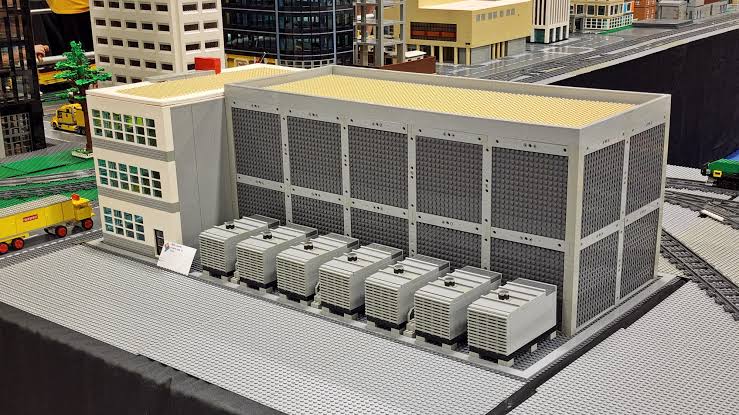
So what did Big Tech do? They basically said “fine, we’ll build data centers like IKEA furniture.” Prefab it in a factory, ship it out, snap it together on-site like giant Lego bricks. According to research firm SemiAnalysis, this isn’t some niche experiment anymore — hyperscalers, colocation providers, even AI labs are treating modular construction as the default playbook now.
It looks like a construction-methods story. It’s actually a labor-shortage story wearing a hard hat.
Meta Went Full “Speed Over Everything”
Meta basically said: forget the traditional data center building. At its Prometheus AI campus in New Albany, Ohio, they’re building under giant industrial tents — aerospace-grade aluminum frames wrapped in industrial fabric — and stuffing factory-built power and cooling modules inside.
Between April and June 2026, Meta cranked out five of these ~125,000-square-foot structures. From breaking ground to going live: about three months. That’s less than half the time a traditional build takes. Absolutely unhinged pace, in a good way.
They also just… skipped some of the usual rulebook. No backup diesel generators. Instead of waiting around for a grid connection (which can take years, no cap), Meta went “behind-the-meter” — installing their own gas turbines to power the racks directly. In Ohio, they signed a 10-year deal with a Williams Companies subsidiary for 400MW of modular gas turbines that bypass the grid entirely.
One tent alone reportedly holds over 20,000 of the latest AI accelerators. One tent. Wild.
AWS Took the Opposite Route (Same Destination Though)
If Meta simplified the outside of the building, AWS went and rebuilt the inside.
AWS is scaling out something called SAMDC, and at the center of it is an internal effort nicknamed “Project Houdini.” The idea: pre-assemble the entire server whitespace — racks, wiring, power gear, all of it — into standardized factory-built units called “skids.” Show up on-site, plug the skid in, done.
The numbers are honestly kind of ridiculous. Server readiness time dropped from up to 15 weeks down to 2-3 weeks. Each skid reportedly saves over 50,000 hours of on-site electrical labor.
SemiAnalysis’s take: AWS isn’t just building bigger warehouses anymore — they’re re-architecting the entire building around the modules that go inside it. Standardize the width, standardize the layout, and suddenly you need less floor space per megawatt and way fewer field connections for cables, pipes, and switchgear. Fewer connections means fewer chances to mess something up.
Wait, “Modular” and “Prefab” Aren’t the Same Thing?
Nope, and this trips people up constantly.
Prefabrication is the broad umbrella — anything built off-site in a factory instead of on-site counts. It’s about where the work happens.
Modular is narrower: it specifically means self-contained units (rooms, boxes, blocks) that arrive basically finished and just get bolted together on-site. Every modular unit is prefabricated. Not every prefab thing is modular.
Break a data center into three layers and it clicks:
- The site — dirt, concrete foundations. Can’t modularize this, sorry, physics says no.
- The shell — the building skeleton, walls, roof.
- The systems — power, cooling, distribution equipment inside.
So “modular data center” really means: factory-build the shell and the systems (the parts you actually can factory-build), truck them in, and assemble fast. Meta simplified the shell. AWS standardized the systems. Different roads, same destination.
Even the Equipment Makers Are Catching the Wave
This isn’t just a hyperscaler thing anymore — power and cooling vendors are all-in too.
Vertiv now bundles switchgear, UPS systems, and controls into a pre-tested “Power Room” that ships mostly assembled — just connect it to the grid on arrival. Lead time: roughly 14 weeks.
Schneider Electric is doing similar prefab power/cooling modules, shrinking on-site construction time from 36 weeks down to 16.
Different companies, same instinct: get as much done in a controlled factory as humanly possible, because the construction site is where things go slow and expensive.
The Actual Math: Is Modular Worth It?
The numbers are genuinely eye-popping. Global modular data center capacity has already blown past 61GW, spread across more than 1,000 sites. By late 2028, over 30% of all data center capacity is projected to be modular.
Speed: Construction timelines drop by about 36%, or 7-9 months. What used to take 24-36 months now takes 12-18. In an industry where idle GPUs are basically burning cash by depreciating while they wait, that’s a massive win.
Cost: Roughly $1.1 million saved per megawatt — about an 8% reduction, thanks to better labor productivity and shorter build times.
Quality: Factory-standardized processes push first-pass inspection rates from a shaky 60-70% up to 95%+.
But — and it’s a real “but”: oversized power rooms and cooling modules are a nightmare to transport. Oversized loads need state-by-state permits, bridge safety reviews, and can take months just to arrange. Then there’s the risk of damage or tip-overs in transit.
And here’s the kicker: commissioning still has to happen on-site, no way around it. Even after passing every factory test, final verification — connecting to the actual grid, backup generators, energy storage — still takes 3 to 8 months. Add in reduced design flexibility and some inevitable double-margin costs, and modular isn’t a magic fix. It’s a very good trade-off.
The Real Bottleneck: Humans With Wire Strippers
Electricians make up 30-40% of the total labor on a data center build. The AI infrastructure boom is moving faster than the skilled trades pipeline can possibly keep up.
SemiAnalysis projects the electrician shortage in key US build zones — think Texas, Ohio — will really bite starting in 2027. Modular construction is, in a very real sense, the industry’s workaround: move repetitive wiring, piping, and power-equipment work into a factory so you’re less dependent on scarce on-site labor.
The alarm bells are already ringing. Brad Smith called the electrician shortage the single biggest obstacle to US data center growth. The International Brotherhood of Electrical Workers (IBEW) has called it a “life or death” issue for Big Tech. Oracle’s year-long delay on its OpenAI-linked data center? Labor shortage, right at the center of it.
The numbers back it up. The US Bureau of Labor Statistics projects the country will need roughly 81,000 additional electricians per year over the next decade. AI infrastructure company Crusoe needed over 9,000 workers at peak for its mega AI data center build in Abilene, Texas — and had to hike on-site wages by 30% just to get people to show up.
Training pipelines are ramping up in response too. Siemens announced plans to train 200,000 electricians and manufacturing specialists by 2030, with Google jumping in as a partner on the program.
Where This Gets Interesting for Emerging Markets
Here’s the part that doesn’t get talked about enough: the modular data center boom isn’t just a construction story. It’s quietly rewiring who gets a seat at the AI infrastructure supply chain table — and a lot of that opportunity is landing in emerging markets.
For the last two years, the AI race was basically “who can hoard the most GPUs.” That phase isn’t over, but a second race has opened up alongside it: grid connections, transformers, cooling systems, and skilled electrical labor are now just as likely to set the pace of a data center build as chip supply is.
That shift is opening real doors for manufacturers across India, China, and Southeast Asia.
Ultra-high-voltage power equipment is probably the biggest opportunity. The US is trying to build AI data centers and replace an aging power grid at the same time, and it simply doesn’t have enough domestic capacity for ultra-high-voltage transformers and substation equipment. Indian electrical equipment manufacturers have been landing sizable export orders for transformers and switchgear as US utilities scramble to fill the gap, and several are expanding domestic manufacturing capacity specifically to serve this demand.
China’s role is more complicated but still significant — Chinese manufacturers remain dominant in components like power electronics and battery/energy-storage systems that feed into data center backup power, even as geopolitical friction reshapes exactly how (and where) that supply chain operates.
Southeast Asia is emerging as the assembly and manufacturing hub of choice, with Vietnam, Malaysia, and Thailand all seeing new investment in electrical component and switchgear production, partly as companies diversify manufacturing footprints beyond a single country.
Distribution equipment is following a similar trajectory. AI data centers don’t just need transformers — they need switchboards, switchgear, circuit breakers, UPS systems, and control systems, all at scale. As modular construction standardizes these components into repeatable factory-built units, manufacturers who can deliver integrated modules — not just individual parts — stand to capture a bigger slice of a supply chain that’s suddenly worth paying very close attention to.
The bottom line: modular data centers are accelerating the standardization of power, cooling, and distribution equipment. And that standardization is turning what used to be a niche B2B hardware market into one of the more interesting emerging-market growth stories tied to the AI boom.
See more insightful blogs!
- “Google vs NVIDIA: Which AI Powerhouse Offers the Better Investment Now?”
- “Oracle’s AI Revolution: The 36% Surge That Changed Everything”
- “China’s Global AI Ambition: The Shocking Strategy Behind Its New Action Plan”
- “Decoding the Fed’s Warning: How $1.1 Trillion in Margin Debt Threatens Your Portfolio”
- “Human API: Why AI Is Now Hiring Humans — Not the Other Way Around”
