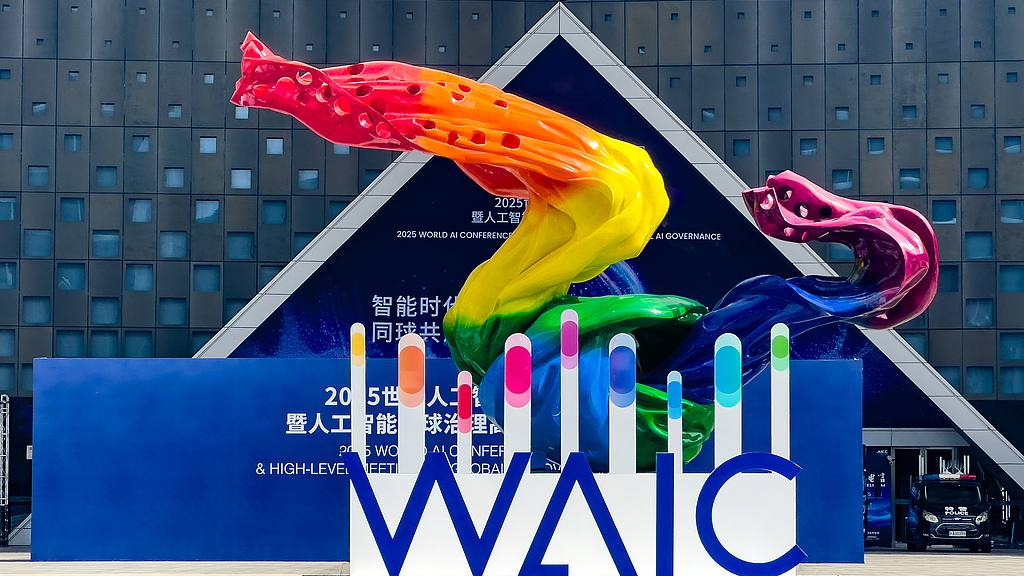
[Shanghai World AI Conference Analysis]
Professor Geoffrey Hinton Proposes ‘International Security Network’ Organization at WAIC
Premier Li Qiang’s Declaration and ‘Chinese Solution’… Will an AI UN Emerge?
Technological Rise Scene… China’s AI Technology Front Lines
Insight Bridge AI’s Perspective: US-China AI Hegemony Direction… What Should Other Nations Do Now?
“Digital intelligence (AI) can replace biological intelligence.”
Geoffrey Hinton, University of Toronto professor and Nobel Prize winner in Physics known as the “Godfather of AI,” warned about AI’s dangers during his keynote speech at the World Artificial Intelligence Conference (WAIC) held in Shanghai on the 26th (local time), stating that “digital intelligence can spread knowledge billions of times faster than humans.”
Considering AI’s characteristics such as ‘efficiency’ and ‘immortality’ – the ability to be replicated without perishing unlike biological entities – AI could surpass human intelligence and spread rapidly in the future. Global movements to competitively expand AI investment and research are accelerating this situation. His argument is that we need to find ways to train AI “cubs” to act as assistants rather than rulers without harming humans.
Professor Hinton suggested that countries should research how to create benevolent AI and share the accumulated experiences and results with the world through international networks. To this end, he specifically proposed that all major AI powers should consider establishing an ‘international security network’ organization.
This aligns with China’s vision of positioning itself as the new architect of ‘global AI governance’ at this WAIC. China, which superficially presented global governance, revealed its ambition to shake the US-centered AI hegemony.
Particularly noteworthy is that this directly conflicts with the US-centered AI policy vision ‘America’s AI Action Plan’ announced by the US government on the 23rd. Industry observers note that China’s emphasis on multilateralism is building justification to challenge the US, which already holds technological hegemony. This resembles how major Chinese tech companies challenge US AI firms with closed models by releasing advanced AI models as open source. The curtain has risen on a geopolitical total war over who will lead the rules, standards, alliances, and core values of AI that will form the foundation of future global order.

Professor Geoffrey Hinton of the University of Toronto (Source: m1a0/acc X)
Premier Li Qiang’s Declaration and ‘Chinese Solution’… Will an AI UN Emerge?
Premier Li Qiang of China’s State Council, who took the podium at the Shanghai WAIC opening ceremony on the 26th, officially proposed the creation of a ‘World AI Cooperation Organization’ and advocated for global governance in the AI era. This proposal was the core of the ‘Global AI Governance Action Plan’ announced at the conference that day. It was an idea presented as a ‘Chinese solution’ to fragmented global AI discussions.
The core principles of governance presented by Premier Li were openness and sharing. The plan is to lower technological barriers and promote open-source cooperation. He emphasized, “We are willing to provide more Chinese solutions to the international community” and “Current overall global AI governance is fragmented. There are particularly large differences between countries in areas such as regulatory concepts and systems.”
Premier Li pointed out that “AI could become an ‘exclusive game of a few countries and companies,'” stating “We will actively share AI technology and development experience especially with developing countries.” This suggests the need to guard against ‘technological monopolies’ where specific countries or a few companies monopolize AI technology. While not specifically mentioning the US, this was clearly criticism aimed at the US-centered big tech ecosystem, with nuances that advanced AI chip exports promote monopolization.
This is why interpretations emerged that these statements were in the same context as China’s major diplomatic strategies such as the ‘Global Development Initiative (GDI)’ and ‘Global Security Initiative (GSI)’ championed by President Xi Jinping. China has been expanding its technological standards and infrastructure worldwide through the ‘Digital Silk Road’ under the banner of respecting national sovereignty and mutually beneficial cooperation.
This AI governance proposal is interpreted as containing intentions to form a new China-centered technological bloc by rallying countries hesitant to join the US-centered technological order, as an extension of this approach. This reflects the logic that China, a UN Security Council permanent member alongside the US, UK, France, and Russia, has recently emphasized in the international community. It’s a strategy to encircle the US by rallying countries and forces concerned about America’s unilateral AI dominance.

Chinese Premier Li Qiang delivering a speech at the opening ceremony of WAIC 2025 in Shanghai. (Source: https://www.stheadline.com/)
Technological Rise Scene… China’s AI Technology Front Lines
Rather than simply presenting governance discourse, China also demonstrated that it is achieving technological self-reliance despite strong US sanctions. WAIC 2025 was utilized as a venue for ‘China’s AI technological rise.’
This conference featured participation from over 800 Chinese and overseas exhibitors, showcasing more than 3,000 exhibits. Representatives from over 30 countries attended, including 12 winners of prestigious awards such as the Turing Award and Nobel Prize, over 80 Chinese and international scholars, and representatives from international organizations like the United Nations Industrial Development Organization.
Particularly in the AI field, over 40 types of Large Language Models (LLMs), over 50 AI-based smart devices, and over 60 types of intelligent robots were exhibited, proving the depth and dynamism of China’s AI ecosystem.
Notably, Chinese big tech companies are aiming for self-reliance in a ‘complete technology stack’ from hardware to software and application services. Their determination to build an independent AI ecosystem in response to US semiconductor export controls was clearly evident.
Additionally, it was confirmed that they are rapidly shifting their focus beyond LLM competition to ‘Embodied AI’ that interacts with the physical world. This is an important change signaling that the next battleground for AI competition will be robots and smart devices that interact with humans in the real world.
Huawei’s ‘CloudMatrix 384’ AI chip cluster is a representative example. This AI chip cluster was built based on Huawei’s self-developed Ascend AI chips. Officially named Atlas 900 A3 SuperPoD, it was first revealed at WAIC 2025. This can be interpreted as a direct challenge to NVIDIA’s GPU ecosystem.
Tencent, Alibaba, Minimax, and others were attracting developers worldwide to their ecosystems through open-source models emphasizing efficiency and openness. Additionally, in the humanoid robots showcased by various companies like Unitree, we could confirm the strong determination to lead the embedded AI revolution, which is the next stage of LLM competition.
These products demonstrated that China’s AI industry is achieving qualitative leaps beyond quantitative expansion. Observations suggest that US sanctions are actually becoming a catalyst accelerating China’s technological self-reliance.

Huawei CloudMatrix 384 AI chip cluster (Source: LiJian2005 X)
Insight Bridge AI’s Perspective: US-China AI Hegemony Direction… What Should Emerging Nations Do?
The US and China recognize the development of Artificial General Intelligence (AGI) that surpasses human-level intelligence as a national survival issue comparable to 20th century nuclear weapons development competition. There’s a widespread belief that the country that first secures AGI will gain decisive advantages in all fields including economics, military, and science.
The US is accelerating AGI research at a level comparable to the ‘Manhattan Project’ or ‘Apollo Program,’ centered on institutions like the Defense Advanced Research Projects Agency (DARPA). As confirmed in the AI Action Plan, America’s goal goes beyond simply achieving technological breakthroughs to securing ‘trustworthy AGI’ that reflects American values and strengthens national security.
Meta’s recently established ‘Superintelligence Institute’ is mentioned as a representative example of private sector activities. Meta established a separate superintelligence research institute with astronomical investment, aiming for AI development at a completely different level than before. Major AI model developers like OpenAI, Anthropic, Google, and xAI are also pursuing the same goal.
In contrast, China set a clear goal in its ‘Next Generation Artificial Intelligence Development Plan’ announced in 2017 to become a major global AI innovation hub by 2030. China’s approach focuses more on spreading AI technology throughout the economy and industry to create substantial added value, rather than the abstract concept of AGI itself.
Simultaneously, academia is making substantial investments in advanced basic research such as bidirectional BCI (Brain-Computer Interface) and Neuromorphic computing (computing methods that mimic the human brain), building potential toward AGI.
China is catching up to the US at a frightening pace in basic research capabilities as well. In the number of top-tier AI paper publications with high citation counts, China has already reached parity with the US. While the US still leads in innovative algorithms like Transformers and deep reinforcement learning, as well as AI ethics, China shows strengths in areas like computer vision for surveillance or industrial applications.
Along with technical aspects, as AI governance philosophies clash as announced at this WAIC, AI hegemony competition is expected to unfold more intensely. While China advocates global cooperation, it has strong nationalism underlying the belief that the state should control technological development, while the US takes a strategy to maintain American hegemony by emphasizing free markets, minimal government intervention, and freedom of expression as core values.

WAIC 2025 MiniMax Booth (Source: orange.ai X)
In this whirlwind, what strategies should emerging market nations adopt to avoid being caught between these two superpowers?
Without joining America’s ‘full-stack AI export package,’ there’s a high possibility of isolation from cutting-edge technology ecosystems, while ignoring China’s economic influence could impact industries like semiconductors. Simply remaining in a parts supplier role would only result in subordination to the strategic movements of the two major powers.
It’s important to secure ‘strategic autonomy’ that can avoid technological dependence and maintain an independent voice between the two giants. While adopting US-led global technology standards, if emerging nations can build vertical technology stacks in sectors where they have secured core data—such as semiconductors, shipbuilding, defense industries, or natural resources—they can secure strategic space to walk their own path.
Investment in game-changing technologies like PIM (Processing-In-Memory) and neuromorphic chips to prepare for the future of AI semiconductors is also necessary. In terms of services and products, experts generally agree that it’s advantageous to build ‘Vertical AI’ services specialized for specific industries by leveraging world-class manufacturing, healthcare, agriculture, or natural resource industries.
Taking on the role of leading the formation of global norms in ‘AI safety, reliability, and ethics’ to drive global agendas is also important. In the AI field, not only technology but also ‘thought leadership’ can have significant influence. By consistently hosting global events like ‘AI Summits’ and continuously securing AI technology’s soft power, emerging nations can expand their influence in the international community.
See more insightful news!
